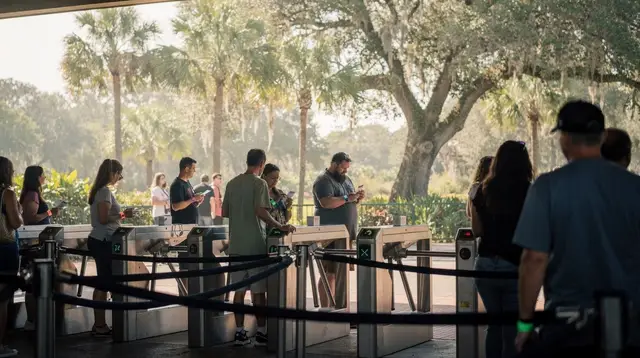
Orlando for visitors with mobility or sensory needs
Can someone with a mobility or sensory disability visit Orlando's theme parks comfortably?
Yes, with planning. The major parks rent wheelchairs and electric scooters on-site, offer sensory guides and quiet rooms, and run adapted-entry programs for guests who cannot wait in standard lines. Most of these programs require registration in advance, sometimes days before arrival, so contact the park directly before the trip rather than counting on same-day setup.
Orlando’s theme park corridor was not built with a single visitor in mind, and that shows in how uneven its accessibility can feel from one attraction to the next. This guide covers what generally exists across the big operators — mobility equipment, adapted-entry programs, sensory support, captioning, transfers, and lodging — without pinning down the exact rules of any one program. Those rules change often enough that a guide claiming to describe them precisely would be wrong within a year. Call or check the operator’s own accessibility page before you travel, and treat everything here as what to ask about, not a guarantee of what you will get.
What a park day actually demands physically
Before equipment and programs, it helps to know the scale involved. Walt Disney World covers about 110 square kilometers across its whole property, but a single theme park gate to gate runs roughly 40 to 100 hectares. Guests without any mobility aid commonly walk 15 to 25 kilometers over a park day — more than most people walk in a week at home. That distance is the first practical fact of any Orlando trip, disability or not, and it is the reason equipment rental is usually the first decision to make, not an afterthought.
Indoor air conditioning runs cold against outdoor heat that regularly sits at 32 to 34 degrees Celsius in summer, which matters for anyone sensitive to temperature swings or managing a condition affected by heat. Dressing in layers, even in August, is standard advice here for exactly that reason.
Wheelchair and scooter rental: on-site versus outside companies
Every major Orlando park — Walt Disney World, Universal Orlando Resort, SeaWorld Orlando, LEGOLAND Florida, Busch Gardens Tampa Bay — rents both standard wheelchairs and electric conveyance vehicles, commonly called ECVs or scooters, at or near the main entrance. This is first-come, first-served in most cases, and scooters in particular can sell out on the busiest days of the year: the week around Christmas and New Year, and spring break in March. A guest arriving mid-morning during peak season with no reservation may find none left.
Outside rental companies serve the same corridor and deliver equipment directly to a hotel room before arrival, with pickup handled the same way at checkout. This costs more than a single park-day rental but removes the risk of showing up to an empty rental counter, and it means the equipment is available for the whole stay, including days spent outside the parks — at Orlando’s hotels or on a day trip. For a multi-day visit during a busy week, booking through an outside company ahead of time is the safer plan. For a single off-peak day, the park counter is usually enough.
Either way, confirm two things before the trip: whether the equipment folds (relevant for transfers and rideshare vehicles), and the maximum weight and size the park allows, since some parks restrict oversized personal mobility devices in certain attraction queues.
Adapted entry and the mistake of waiting until the morning of
Every major operator runs some form of program for guests who cannot tolerate a standard queue because of a disability, whether that is a mobility limitation, a medical condition, or a sensory or developmental one. The shape of these programs changes by park and by year — a return-time system, a registration through an app, or a same-day check-in at guest relations have all been used across different operators, sometimes by the same operator in different seasons. Because the exact mechanics shift, this guide will not describe one as if it were fixed; treat any specific program name or process you read elsewhere as provisional and verify it directly with the park before departure.
What stays consistent, and is the single most important thing to know here, is timing: these programs are generally set up in advance, not at the ticket gate on the morning of the visit. Some parks want an online request submitted days ahead. Others want the guest to register at guest relations first thing, before joining any other line, rather than mid-morning after already touring part of the park. Arriving without having looked into this, and assuming it can be sorted out on the spot at 11 a.m., is the most common and most avoidable mistake covered in this guide. Build a stop at guest relations, or an online registration, into the very start of the trip planning — not the itinerary for day one.
Documentation requirements also vary. Some programs ask for nothing beyond a conversation with a cast member or team member; others may request more. Do not travel assuming either extreme — ask the specific park what, if anything, is needed.
Sensory guides and quiet spaces
Guests managing autism, sensory processing differences, or conditions like migraine or epilepsy have another layer to plan around: noise, strobe lighting, sudden drops, fog, and crowd density vary enormously between attractions in the same park. The major operators publish some form of sensory or accessibility guide — often a downloadable chart flagging loud sound, darkness, strobe effects, and motion intensity per attraction — and several parks maintain a quiet room or low-sensory space away from the main crowd flow where a guest can decompress mid-day.
These guides and spaces exist, but their detail, location, and even availability shift between seasons and after park refurbishments. Rather than relying on a screenshot from a prior trip, pull the current version from the park’s own guest services page in the weeks before travel, and ask at guest relations on arrival where the quiet space is that day — some parks relocate it around seasonal events like Halloween or Christmas overlays.
Captioning and audio description
Handheld captioning devices, reflective captioning panels, and audio description receivers are available for a meaningful share of shows and some ride-through attractions across the big parks, generally issued from guest services against a refundable deposit or photo ID. Coverage is per-attraction, not park-wide — a park with dozens of shows and rides will not have every one of them equipped, and which ones are covered changes as attractions rotate in and out of service. Ask guest services on the day for a current list rather than assuming last year’s coverage still applies. Sign language interpretation for specific shows, where offered, is usually scheduled for set days and times and needs advance notice through the park’s accessibility desk.
Getting from MCO with a wheelchair or scooter
Orlando International Airport (MCO) sits roughly 25 to 45 minutes from the parks corridor depending on traffic on the I-4. Not every transfer option handles a non-folding wheelchair or scooter. A standard sedan or a shared shuttle van often cannot, since they lack a ramp or lift and have limited cargo space. Wheelchair-accessible transfer vans, with a ramp or lift and tie-down points, operate on this route through several private transfer companies, and this is the category to specifically request when booking — not assume by default. Rideshare apps offer an accessible vehicle option in some markets, but availability in Orlando is inconsistent enough that it should not be the only plan for an airport pickup.
Book the accessible vehicle at the same time as flights, not after landing. On arrival, curbside pickup points for accessible vans are sometimes separate from the general rideshare and taxi queue, so confirm the pickup location with the transfer company in advance.
A rental car with hand controls or a wheelchair-accessible van is a separate booking category from a standard rental and typically needs more lead time — weeks rather than days — since fleets are small relative to demand. If driving yourself around Central Florida is part of the plan, this is one of the first things to lock in, well before choosing a hotel.
Where to stay: roll-in showers and step-free access
Hotels along International Drive and the US 192 corridor in Kissimmee, along with the major on-property resort hotels, generally include a number of ADA-designated rooms with features like roll-in showers, grab bars, lowered vanities and closet rods, and visual alert systems for fire alarms and door knocks. These rooms are a limited share of total inventory, not the default room type, and they are the first to sell out during high-demand weeks like Thanksgiving, Christmas, and spring break.
Request the specific accessible room type by name when booking, and call to confirm it rather than trusting a website filter, since online systems do not always reflect real-time availability of that exact category. If a roll-in shower specifically is required — as opposed to a tub with a grab bar, which is a different and more common accessible configuration — say so explicitly, because the two get grouped together in some booking systems.
Staying on property versus off matters here too: on-property resort hotels tend to have more accessible-room inventory relative to their size and often run their own accessible shuttle service to the parks, which removes one transfer step from the day. Off-property hotels on International Drive are usually cheaper and closer to non-Disney attractions but vary more in how many accessible rooms they carry.
Slower days that still make a good trip
Not every day of an Orlando trip needs to be a full theme park day, and for many visitors managing a mobility or sensory condition, mixing in lower-intensity days makes the whole trip more sustainable. An indoor, climate-controlled, low-walking option like the Madame Tussauds wax museum on International Drive or the nearby arcade and mystery fun house attraction covers a few hours without the walking distance or sensory intensity of a major park. A seated evening out, such as the Medieval Times dinner and show, needs no queue navigation at all beyond the entrance. For something outdoors but compact and mostly step-free, the Central Florida Zoo, north of the city, covers far less ground than a theme park while still filling a half-day.
Spacing one of these into a week of park days, alongside a stretch of pool time or rest at the hotel, tends to matter more for comfort and stamina than any single piece of equipment or program.
Planning timeline at a glance
| When | What to do |
|---|---|
| 6 to 8 weeks before | Book accessible airport transfer and confirm hotel’s specific accessible room type by phone |
| 2 to 4 weeks before | Look into each park’s current disability access program and registration process |
| 1 to 2 weeks before | Download current sensory guides; decide on outside scooter/wheelchair rental if visiting during a busy week |
| Morning of arrival at each park | Stop at guest relations first, before joining any other line, if same-day registration applies |
Accessible Orlando: frequently asked questions
Do I need to book mobility equipment before arriving in Orlando?
You do not have to, but it helps. Parks rent wheelchairs and scooters at the entrance on a first-come basis, and supply runs out on busy days, especially scooters. Outside rental companies deliver to hotels and can guarantee equipment in advance, which is the safer choice during holiday weeks.
How far ahead should I register for a park’s disability access program?
Policies vary and change, but the common mistake is assuming it can be done at the gate the morning of a visit. Most parks want guests to contact them, complete an online request, or speak with guest services before the visit or on arrival before starting the day, not mid-morning after standing in a first line. Confirm the exact process with each park before departure.
Are Orlando’s theme parks manageable for someone who cannot walk long distances?
A single theme park covers roughly 40 to 100 hectares (100 to 250 acres) gate to gate, and guests without mobility aids typically log 15 to 25 kilometers a day on foot. A rented scooter or wheelchair removes most of that burden, but transfers between rides, restrooms, and dining still involve walking or maneuvering, so build in rest breaks regardless of equipment.
What sensory support is available for visitors with autism or sensory sensitivities?
The major Orlando parks publish sensory guides that flag loud, dark, or strobe-heavy attractions, and several offer quiet rooms away from crowd noise for guests who need to decompress. Availability and exact locations change by park and season, so check the current guest services page or ask at guest relations on arrival rather than relying on an older guide.
Is captioning or audio description available at Orlando attractions?
Many major attractions and shows offer assistive devices such as handheld captioning units, reflective captioning, or audio description receivers, usually issued from guest services against a refundable deposit or ID. Coverage is attraction by attraction, not park-wide, so ask guest services for a current device list rather than assuming every show is equipped.
Can I get an accessible transfer from Orlando International Airport to my hotel?
Yes. Several shuttle and private transfer operators run wheelchair-accessible vans with ramps or lifts between MCO and the parks corridor, roughly 25 to 45 minutes away, but standard sedans and many shared shuttles are not equipped for a non-folding wheelchair or scooter. Request an accessible vehicle when booking, not on arrival at the curb.
Do Orlando hotels near the parks have roll-in showers?
Most major chains and resort hotels in the International Drive and US 192 corridors offer a number of ADA-designated rooms with roll-in showers, grab bars, and lowered fixtures, but these rooms are a limited share of total inventory and sell out first during busy weeks. Request the specific room type by name when booking, and confirm it by phone rather than trusting a generic filter online.
Accessibility guides for wheelchair users and more on GetYourGuide
Verified deep-linked GetYourGuide tours. Book through these links and we earn a small commission at no cost to you.
GetYourGuide does not provide a product photo for this activity — the image shows the meeting point, photographed by us.