A working city on a bay, not a beach resort
Tampa is the largest city on Florida’s Gulf side and the most straightforward day trip west from Orlando: about 1 hour 20 minutes to 1 hour 30 minutes, roughly 135 km (84 miles), straight down the I-4. What Tampa is not is a beach town. It sits on Tampa Bay, an inlet of the Gulf of Mexico, and its downtown waterfront is bay, marina, and cruise terminal rather than open sand. The sand — Clearwater, St. Pete Beach — is another 30 to 45 minutes further west. Booking a Tampa hotel expecting to walk out onto a beach is the single most common planning mistake for this destination, and it means a daily drive to the coast for the rest of the trip.
What Tampa does have is a city with actual layers: a downtown business core stitched together by a riverside path, a 19th-century cigar-making district that has become the nightlife strip, a grand old residential neighborhood along the bay, a safari-style theme park at the northeast edge near the university, and a working cruise port. It rewards a full day on foot and in the car, in a way most of the theme-park corridor does not.
How the city is laid out
Downtown Tampa sits on the west bank of the Hillsborough River, with the Tampa Riverwalk running roughly 2.4 miles along the water, linking Curtis Hixon Waterfront Park, the Tampa Museum of Art, the Florida Aquarium, and Sparkman Wharf. It is flat, shaded in patches, and the easiest way to get a feel for downtown without a car.
Ybor City sits about a mile and a half northeast of downtown, an easy rideshare or streetcar ride away. Founded in the 1880s around cigar manufacturing by Cuban and Spanish immigrants, its brick factory buildings along 7th Avenue (La Séptima) now hold restaurants, cigar shops that still hand-roll, and — after dark — Tampa’s densest concentration of bars and clubs. It reads completely differently by day (history, food) and by night (nightlife), and both are worth doing.
Hyde Park, southwest of downtown along Bayshore Boulevard, is the old-money residential district: live oaks, early-1900s houses, and a 4.5-mile continuous sidewalk along the bay that locals use for running and walking. Hyde Park Village adds boutique shopping and restaurants.
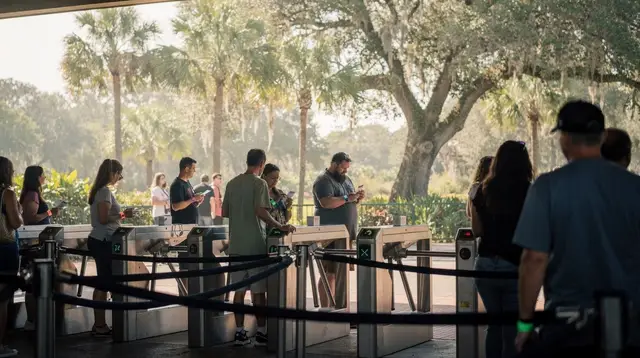
Busch Gardens Tampa Bay sits well north of downtown, near the University of South Florida, roughly a 20-minute drive from the Riverwalk. It shares ownership with SeaWorld Orlando and is frequently bundled with it — the two are commonly cross-sold as a combined ticket. Ticket and ride details live in the dedicated guide rather than here.
Port Tampa Bay, east of downtown, is one of Florida’s busiest cruise ports, with sailings to the western Caribbean and Mexico. If a cruise is the reason for the visit, a pre- or post-cruise night in downtown Tampa is a reasonable base; a beach-adjacent Clearwater hotel is not, given the drive.
Getting around
Tampa is drivable but not compact. The Hillsborough Area Regional Transit (HART) TECO Line Streetcar connects downtown to Ybor City and is the easiest link between those two districts without a car. Beyond that corridor, a rental car or rideshare is realistic — Tampa’s public transit does not reach Busch Gardens or the beaches on a useful schedule. Tampa International Airport (TPA) is a genuine alternative arrival point for anyone building a trip around this side of the state; it consistently ranks among the more pleasant US airports to use.
What there is to do, by category
Theme park and zoo. Busch Gardens Tampa Bay combines roller coasters with an accredited zoo and safari-style animal areas — closer to a wildlife park with thrill rides bolted on than a pure theme park. A Serengeti-style safari excursion inside the park adds an up-close animal encounter beyond the standard walking paths.
Museums and the aquarium. The Florida Aquarium sits on the Riverwalk. St. Petersburg, 30-45 minutes further, holds the larger cultural draws — the Dali Museum and the Chihuly Collection — commonly visited on the same day trip as Tampa. The Tampa Museum of Art anchors the downtown end of the Riverwalk.
Waterfront walking. The Riverwalk downtown and Bayshore Boulevard in Hyde Park are the two set-piece walks: one urban and museum-lined, the other residential and bay-facing.
Cuban food and Ybor City. Ybor’s Cuban sandwich, café con leche, and cigar-rolling shops are the district’s identity by day; a guided walk through the historic factory buildings puts the 1880s immigration story in context before the bars take over after dark.
Bay boat trips. Sunset cruises past waterfront mansions, dolphin-watching, and snorkeling excursions run out of the Tampa Bay area and nearby St. Pete Beach — a way to see the bay itself rather than just its edge.
Nightlife. Ybor City’s 7th Avenue is Tampa’s after-dark district: live music venues, clubs, and late-night food, concentrated in a few walkable blocks.
Outdoor and green space. Beyond the Riverwalk and Bayshore Boulevard, Tampa has a genuine park system: Curtis Hixon Waterfront Park hosts festivals and food-truck rallies through the cooler months, and the riverside path connects to Water Works Park, a former industrial site turned green space with a beer garden and a view back across the river to downtown. None of this replaces a beach, but it is enough to fill an evening without a car.
Sports. Tampa is a genuine sports city — the Tampa Bay Buccaneers (NFL), the Tampa Bay Lightning (NHL), and spring training baseball all draw visitors whose trip planning has nothing to do with theme parks. A game downtown pairs naturally with an Ybor City dinner beforehand, since both sit within a short rideshare of each other.
Where to stay
Downtown Tampa puts the Riverwalk, the aquarium, and the streetcar to Ybor City within walking distance, and is the natural choice for a cruise passenger or anyone without a car for the first night. Ybor City itself has a smaller but growing set of boutique hotels inside converted cigar-factory buildings — atmospheric, and close to the nightlife, at the cost of noise on weekend nights. Hyde Park is quieter and more residential, better suited to a traveler prioritizing the Bayshore Boulevard walk and a slower pace over proximity to bars. None of the three puts a swimmable beach within walking distance; that trade-off is unavoidable on this side of the bay, and it is the reason Orlando vs. Tampa as a base is worth reading before booking multiple nights here.
When to go
Tampa follows the same subtropical pattern as the rest of central Florida: hot, humid, and prone to a near-daily afternoon thunderstorm from June through September, with temperatures in the low-to-mid 30s C (low 90s F) and heavy humidity on top. November through April is the comfortable window — mild, drier, and the best stretch for walking the Riverwalk or Bayshore Boulevard without retreating indoors by 2 p.m. Hurricane season runs June 1 to November 30, peaking August through October; a direct hit is rare but a storm passing anywhere in the Gulf can still bring wind, rain, and flight disruption to Tampa even without making landfall there.
Costs, roughly
| Item | Typical range (USD, before tax) |
|---|---|
| Downtown/Ybor hotel, per night | 130-260 |
| Busch Gardens single-day ticket | 100-140 |
| Sunset or wildlife boat cruise | 40-90 per person |
| Cuban sandwich lunch | 12-18 |
| Dinner, Ybor City restaurant | 20-40 per person |
| Museum admission (Dali, Florida Aquarium) | 25-36 |
Florida sales tax plus Hillsborough County’s surtax applies on top of listed prices, and hotel stays add the local lodging tax — the same pattern as everywhere else on the [Sites], so budget a few percent above the sticker price.
A day trip from Orlando, or a base of its own
For most Orlando-based visitors, Tampa works best as a single long day trip: Riverwalk and the aquarium or museum of choice in the morning, Ybor City for lunch and a walk through the history, Bayshore Boulevard or a bay cruise for the afternoon, back on the I-4 before evening traffic builds. Adding Busch Gardens turns it into an overnight, since the park alone is a full day.
Using Tampa as a multi-night base for a beach vacation is the miscalculation to avoid: every day would start with a 30-to-45-minute drive out to Clearwater or St. Pete Beach and back. A traveler who wants both the city and the sand is generally better served basing in St. Petersburg or Clearwater and treating Tampa itself as the day trip in reverse — see Orlando vs. Tampa as a base for the fuller comparison.
Pairing Tampa with the rest of the Gulf coast
Tampa Bay is the hinge for a wider Gulf-coast loop, not just a single stop. St. Petersburg, across the bay, has its own guided district tours and a growing mural walking tour scene downtown, plus a craft brewery circuit that pairs naturally with an Ybor City night if the itinerary allows two evenings on this coast. Further south, Sarasota and Bradenton add mangrove kayaking and barrier-island beaches for travelers extending the trip beyond a single day. North of Tampa, Crystal River is the manatee-swimming counterpart to Blue Spring back on the Orlando side of the state — a full day on its own rather than a Tampa add-on.
For visitors building a longer Gulf-coast stretch rather than a single day trip, Clearwater is the natural overnight base: its barrier-island beaches are consistently ranked among Florida’s best, and it sits close enough to Tampa and St. Petersburg to fold both into day trips without the Bayshore Boulevard drive being the whole story. A Tampa Bay sunset cruise booked from the St. Pete Beach side rather than downtown Tampa is often the better version of the same experience, since it starts closer to open water and clearer sunset views.
For a deeper look at Ybor City itself beyond the daytime walking tour, a dedicated food and cigar tasting covers the district’s Cuban, Spanish, and Italian immigrant layers through its restaurants, while an after-dark haunted night tour leans into the same brick-factory streets once the bars open. Both work as an alternative to, or a follow-up on, the historic walking tour covered above.
Tampa Bay area: frequently asked questions
How far is Tampa from Orlando?
About 135 km (84 miles), roughly 1 hour 20 minutes to 1 hour 30 minutes by car on the I-4, traffic and construction permitting.
Is Tampa on the beach?
No. Tampa sits on Tampa Bay, an inland-facing inlet, not the open Gulf of Mexico. The nearest sand beaches — Clearwater Beach and the St. Pete Beach barrier islands — are a further 30 to 45 minutes west by car.
Can I visit Tampa as a day trip from Orlando?
Yes, and it’s one of the more reasonable day trips on this side of the state. A full day covers downtown’s Riverwalk and Ybor City comfortably; adding Busch Gardens turns it into an overnight.
Is Busch Gardens Tampa Bay worth combining with SeaWorld Orlando?
The two parks share ownership and are frequently sold as a combined ticket, which can be worth it for visitors doing both cities. Ticket structures and pricing are covered in the Busch Gardens Tampa Bay tickets guide rather than here.
What’s the best time of year to visit Tampa?
November through April, when heat and humidity ease and afternoon thunderstorms are rare. Summer (June-September) is hot, very humid, and brings a near-daily afternoon storm.
Is Ybor City safe at night?
Ybor’s main strip is well-lit, busy, and policed like any dense nightlife district, but it draws a late-night bar crowd — the usual city-nightlife precautions apply rather than any Tampa-specific risk.
Do I need a rental car in Tampa?
For downtown and Ybor City alone, the streetcar and walking cover it. For Busch Gardens, Hyde Park’s outer stretches, or any beach day, a car or rideshare becomes necessary.
Should I fly into Tampa (TPA) or Orlando (MCO) for a trip that covers both cities?
Either works as an entry point; the choice usually comes down to which city gets more nights on the itinerary. TPA is smaller and generally faster to clear than MCO, which matters more for a short trip.
How does Tampa compare to St. Petersburg for a first visit?
Tampa has the bigger downtown, the cruise port, and Busch Gardens; St. Petersburg, across the bay, has the Dali Museum, a denser arts and mural scene, and closer access to the barrier-island beaches. Neither replaces the other — most multi-day Gulf-coast itineraries cover both, and many bases split the difference by staying in St. Petersburg and day-tripping into Tampa rather than the reverse.
Is one day enough to see Tampa properly?
For downtown and Ybor City, yes — a single day covers the Riverwalk, a museum, and a walk through the historic district comfortably. Busch Gardens alone is a full day on its own, so a visitor wanting both the city and the park should plan on two days or accept seeing only one side of Tampa on a single-day trip.
Nearby: St. Petersburg, Clearwater, Sarasota, Bradenton, and Crystal River round out the Gulf side; back on the parks corridor, see Orlando and Kissimmee. Planning help: best day trips from Orlando, Orlando vs. Tampa as a base, and renting a car in central Florida. For the safari-style animal encounter inside the park, consider the Tampa Bay Serengeti safari tour. To get oriented in the historic cigar district, a guided historic walking tour of Tampa covers the Ybor City background in about two hours. St. Petersburg’s Dali collection is worth the detour, bookable as the Dali Museum gallery admission ticket. For an evening on the water, the Tampa Bay sunset cruise past waterfront mansions and wildlife is a low-effort way to see the bay from the water rather than its edge.