Dolphin watching in Clearwater: what to actually expect
How likely are you to see dolphins on a Clearwater dolphin cruise?
Very likely but not certain. Bottlenose dolphins live year-round in the waters around Clearwater Pass and the Intracoastal Waterway, and most one-hour cruises report sightings on the large majority of trips, best on calm, early-day water.
Why Clearwater has dolphins to watch in the first place
The bottlenose dolphins around Clearwater aren’t migratory visitors passing through on a schedule. They’re year-round residents of Clearwater Pass, the Intracoastal Waterway, and the grass flats behind the barrier islands, living in small pods that locals and boat captains recognize individually by scars and fin shape. That residency is the single fact that makes a Clearwater dolphin cruise worth planning around: you’re not betting on a seasonal run the way you would for whale watching further north, you’re looking for animals that are there most days, doing what they do every day, whether or not a boat shows up.
That doesn’t mean every hour is equal. Dolphins feed opportunistically, following bait fish stirred up by tidal current, and they’re easiest to spot when the water is flat enough to see a dorsal fin break the surface from 100 meters away. Wind chop, boat wakes, and glare all work against you. So the honest version of “will I see dolphins” isn’t a yes or no — it’s a question of stacking conditions in your favor, and that starts with what time you book.
Morning, flat water, and why it matters more than luck
Central Florida’s Gulf coast runs on a predictable daily rhythm in the warmer months: calm air at sunrise, building onshore breeze through the late morning, and by mid-to-late afternoon a chop that can make a small boat uncomfortable and a dolphin’s fin nearly invisible in the glare. That’s before you factor in the near-daily summer thunderstorm pattern that tends to build over the peninsula by early-to-mid afternoon.
The practical upshot: the first one or two morning departures on any dolphin-watching operator’s schedule consistently produce the best combination of flat water, good light, and calm passengers. Captains who run this route daily will tell you the same thing without prompting — mornings are when the water “goes glassy,” and glassy water is when you actually see the animal instead of a flash of gray in a whitecap.
This is also where the common booking mistake shows up: locking in an afternoon slot in July or August because it fits the day’s plan, then getting a bouncy ride with poor visibility and a storm cell building on the horizon by the time the boat turns back. It’s not that afternoon trips see nothing — many do — but you’re working against the conditions rather than with them. If dolphin sightings are the actual goal rather than just being on the water, book the earliest reasonable departure.
Cruise formats — what changes for photos, comfort, and kids
Clearwater’s dolphin-watching fleet isn’t one type of boat. The format you pick changes the ride, the sightlines, and how close you realistically get.
| Format | Typical capacity | Ride | Best for |
|---|---|---|---|
| Large catamaran | 40–100+ passengers | Steady, minimal rocking, shaded deck | Families with young children, larger groups, anyone unsteady on water |
| Mid-size cruiser | 20–40 passengers | Moderate, open rail access | A balance of stability and closer views |
| Small speedboat / rigid-hull | 6–20 passengers | Faster, more motion, lower to the water | Photographers, smaller groups, tighter turns into passes and mangrove edges |
A large catamaran, the kind used on a dolphins-and-donuts style morning cruise, is the easiest choice with toddlers or grandparents aboard — there’s shade, bench seating, restrooms on some boats, and enough deck space that nobody needs to lean over a rail to see anything. The tradeoff is that with more passengers, you’re sharing rail space when dolphins do appear, and the boat can’t maneuver into shallow passes the way a smaller vessel can.
A small, fast boat sits low enough that dolphins occasionally ride the bow wake, which is the closest and most photogenic encounter this activity offers within the legal distance rules below. It also rocks more, turns tighter, and isn’t the right pick for a child prone to seasickness or an adult who needs a stable deck. For serious photography — long lenses, tracking a moving fin against water glare — the lower vantage and maneuverability of a small boat usually wins over the catamaran’s steadier but higher, more distant view.
There’s no universally “better” format here. It’s a tradeoff between stability and closeness, and worth matching to who’s actually on the trip.
The distance rules, and why a “guaranteed close encounter” is a red flag
Wild bottlenose dolphins in U.S. waters are protected under federal law, which sets a recommended minimum approach distance of 50 yards (about 46 meters) and prohibits feeding them. Reputable captains run parallel to a pod’s direction of travel, cut engine speed as they approach, and let curious dolphins close the gap themselves rather than driving the boat toward them. Feeding, chasing, or trying to touch a dolphin from a boat isn’t just discouraged — it’s illegal, and it also changes wild animal behavior in ways that make future encounters riskier for boats and dolphins alike.
This matters for how you evaluate operators, not just for compliance. Any tour marketing itself around a “close encounter” or “swim with dolphins” experience in open Gulf water — as opposed to a supervised program elsewhere — is describing something that either isn’t legal as advertised or isn’t accurately advertised. A dolphin that voluntarily rides a bow wake or surfaces near a boat is behaving naturally and isn’t being coaxed; that’s different from a company promising proximity as a deliverable. If in-water swimming with dolphins is what you’re after rather than watching from a boat, that’s a different, tightly regulated category of experience — see the separate comparison of swim programs versus boat-based cruises rather than expecting it on a standard Clearwater watching cruise.
Fitting it into a day from Orlando
Clearwater is roughly 2 hours from Orlando by car, about 170 kilometers (105 miles), mostly via I-4 west toward Tampa and then across to the barrier islands. That’s a long day trip but a workable one if you leave by mid-morning at the latest — which, given the case for early departures above, pushes toward staying overnight or accepting a mid-morning rather than sunrise cruise slot when coming from Orlando same-day.
A common and sensible pairing is the Clearwater Marine Aquarium on the same day as a dolphin cruise. The aquarium isn’t a dolphin show — it’s a working rescue and rehabilitation center, home to Winter, the resident dolphin made known by a prosthetic-tail documentary, along with sea turtles, otters, and other animals unable to return to the wild. Seeing a resident, non-releasable dolphin up close at the aquarium alongside wild dolphins spotted from a boat gives a rounded, honest picture of the species in this part of Florida — one in captivity for a documented reason, the other living free offshore. Late morning cruise, afternoon aquarium (or the reverse) is an easy sequence, and both sit within walking or short-drive distance of Clearwater Beach.
If beach time matters as much as the cruise, Clearwater Beach itself — quartz-sand, consistently ranked among the country’s best beaches — is a few minutes from most cruise marinas, so a morning boat trip followed by an afternoon on the sand is a natural full day without much driving between stops.
What this page doesn’t cover
Two related experiences get their own dedicated pages rather than a mention here. In-water dolphin swim programs — a distinct, tightly regulated category separate from a boat-based watching cruise — are covered in dolphin cruise versus swim programs. And dolphin watching in Sarasota Bay, a separate stretch of Gulf coast with its own operators and conditions, has its own writeup at Sarasota Bay dolphin and wildlife cruise. If Crystal River and swimming with manatees rather than dolphins is the goal, that’s a different animal and a different season — start at manatee swim in Crystal River.
The one booking mistake worth avoiding
Booking an afternoon cruise in summer for the sake of convenience is the single most common way to end up disappointed. By early-to-mid afternoon from roughly June through September, the Gulf coast’s daily thunderstorm pattern is often already building, and the onshore breeze has usually turned flat morning water into a chop that makes both visibility and comfort noticeably worse. A cruise that gets cut short or rerouted around weather, or one where the boat is pitching enough that photos are difficult and small kids are uneasy, is rarely one that gets rebooked. If the schedule allows any flexibility at all, the earliest available departure is worth prioritizing over what otherwise looks like the more convenient slot.
For travelers building this into a wider Gulf coast day, pairing a morning cruise with sights like Ybor City or St. Petersburg’s Dali Museum on the return route toward Orlando keeps a long driving day feeling like two destinations rather than one long haul.
Booking a cruise
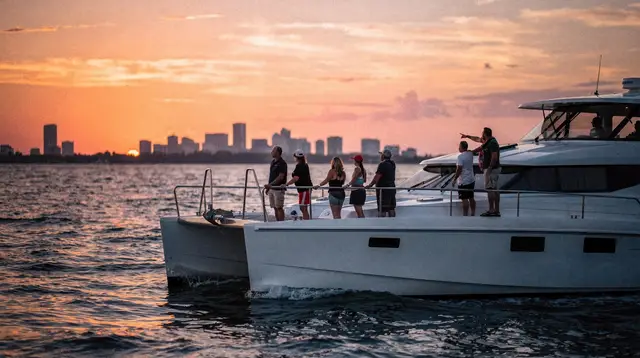
an early-morning dolphin-watching cruise with breakfast on board lines up with the flat-water window described above and is the pick if sightings are the priority. For a faster, lower-to-the-water ride with tighter maneuvering near the pass, a smaller dolphin discovery boat tour suits photographers and smaller groups. Families who want a steady, shaded deck and a relaxed pace can look at a tiki-style cruise around Clearwater Beach’s waterways, which often spots dolphins along the way without being marketed purely as a wildlife trip. And for scenery over guaranteed sightings, a sunset dolphin-watching cruise out of Clearwater Beach is the evening option, best treated as a sunset outing with a good chance of dolphins rather than the reverse.
Dolphin watching in Clearwater: frequently asked questions
Are dolphin sightings guaranteed on a Clearwater cruise?
No operator can guarantee wild dolphins, and any that promises a close encounter is worth avoiding. What’s true is that bottlenose dolphins are year-round residents of the Clearwater area, so most morning trips on calm water do see them, often more than once.
What time of day is best for dolphin watching in Clearwater?
Early morning, roughly the first two departures of the day. The water is flattest before the afternoon sea breeze picks up, which makes dorsal fins easier to spot at a distance and keeps the ride comfortable for kids and anyone prone to seasickness.
How close can a boat legally get to a dolphin?
Federal guidelines call for staying at least 50 yards (about 46 meters) from wild dolphins and never approaching head-on or cutting off their path. Feeding wild dolphins is illegal. Reputable operators let the animals approach the boat rather than chasing them.
What’s the difference between a big catamaran and a small speedboat tour?
A large catamaran carries 40 to 100-plus passengers, runs a fixed schedule, and is steadier underfoot, which suits families with small children or anyone unsteady on a boat. A small rigid-hull boat carries 6 to 20 people, gets closer to the mangroves and passes, and gives sharper sightlines for photos, but rocks more.
Should I combine dolphin watching with the Clearwater Marine Aquarium?
Yes, they pair well on the same day. The aquarium is a rescue and rehabilitation center, not a dolphin show, so seeing a resident dolphin, Winter, up close there alongside wild dolphins offshore gives a fuller picture in a single Clearwater day trip.
Is a sunset cruise a good choice for dolphin watching?
It’s a good sunset cruise, but a secondary dolphin option. Late-day water is often choppier from the afternoon breeze, and in summer a storm can roll through in the last hour of daylight, so treat sunset trips as a scenery outing with a chance of dolphins, not the reverse.
Do I need to book in advance?
In peak season, yes, especially for the first morning departure, which sells out first because everyone eventually learns it has the best conditions. In the quieter months, same-day booking is usually possible, but the morning slots still go first.
How far is Clearwater from Orlando for a day trip?
About 2 hours by car, roughly 170 kilometers (105 miles), mostly on I-4 west and then toward the Gulf coast. It’s a long but manageable single-day round trip if you leave Orlando by mid-morning and plan the cruise for the first half of the day.
Dolphin watching cruises along the Gulf coast on GetYourGuide
Verified deep-linked GetYourGuide tours. Book through these links and we earn a small commission at no cost to you.
GetYourGuide does not provide a product photo for this activity — the image shows the meeting point, photographed by us.