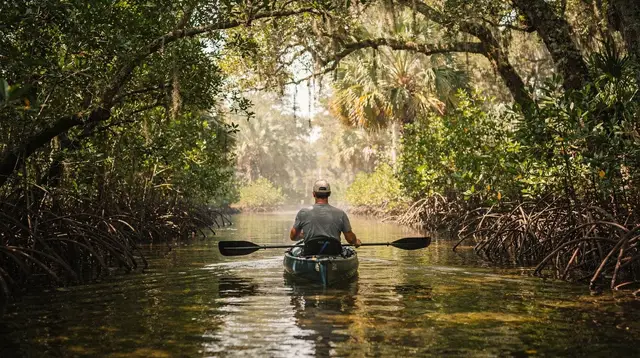
Swimming with manatees in Crystal River
Can you really swim with manatees near Orlando?
Yes, in Crystal River, about two hours from Orlando. It is the only place in the United States where entering the water with wild manatees is legal, under strict passive-observation rules: you float, you do not chase or touch them, and refuge zones stay off-limits. Season runs November through March.
The only legal in-water manatee encounter in the country
Crystal River, on the Gulf coast about two hours from Orlando, is the single place in the United States where getting into the water with wild manatees is legal. Everywhere else in Florida — Blue Spring State Park, the St. Johns River, the springs of the Ocala National Forest — manatee viewing happens from a boardwalk, a boat, or a kayak, never from the water itself. That distinction exists because of Kings Bay, a cluster of more than seventy spring vents feeding Three Sisters Springs and the surrounding waterways, all holding a constant 22 degrees Celsius (72 Fahrenheit) year-round. When the Gulf cools in winter, manatees move into that warm, stable water in numbers, and a federal rule permits guided, passive in-water observation of them here specifically.
It is worth saying plainly what this activity is not. It is not a marine park encounter, not a touch tank, and not a guaranteed close-up. It is a wild animal in its own habitat, observed under a legal framework built to protect a threatened species from the people who come to see it.
What “passive observation” means in the water
Every operator opens the morning with a mandatory briefing, run through by federal and state guidelines, before anyone gets in. The rules are consistent across companies because they are legal requirements, not house style:
- Float or tread water quietly; do not swim toward a manatee or chase one that moves away.
- Keep both hands to yourself. If a manatee approaches and brushes against you, that is the animal’s choice; you do not reach out, grab a fin, or hold on.
- No feeding, no offering water from a bottle — manatees that learn to associate people with food change behavior in ways that put them at risk around boats.
- Stay out of marked refuge zones and sanctuaries, including large sections of Three Sisters Springs and Kings Bay during the winter season. These closures exist precisely because manatees need water where no one is allowed to swim near them.
- One hand on the surface at most; no free-diving down to an animal on the bottom.
Guides in the water reinforce this constantly, and it is normal for a guide to redirect swimmers away from a resting animal rather than toward it. A manatee that wants distance gets distance. This is the entire point of the activity being legal at all: it works because it stays passive.
A typical morning, start to finish
a small-group manatee swim tour in Crystal River usually runs to a predictable shape, and knowing it in advance makes the early start easier to plan around.
| Time | What happens |
|---|---|
| Before dawn | Check-in at the dock or a hotel pickup point; wetsuits fitted |
| ~30 minutes | Mandatory manatee etiquette briefing (federal rules, hand signals, refuge boundaries) |
| Boat ride | Short run by pontoon or small boat to that morning’s spring |
| ~2.5–3 hours | In-water time: floating, snorkeling, moving between spots as guides find manatees |
| Return | Boat back to the dock, gear returned, tour ends by late morning |
The wetsuit is not optional gear for comfort’s sake — it is standard issue because a few hours in 22-degree water gets genuinely cold, including in August. A mask and snorkel are provided; bring your own if you have a preferred fit, along with reef-safe sunscreen applied well before the wetsuit goes on, water shoes if you have them, and a dry change of clothes for after. Most companies supply the noodle-style flotation aid used for resting on the surface without kicking near an animal below.
Departures cluster in the early morning for a practical reason, not just tradition: boat traffic on Kings Bay picks up through the morning, stirring sediment and pushing manatees toward the closed refuge areas where swimmers cannot follow. A 7 a.m. departure regularly sees calmer, clearer water and more animals in open zones than an 11 a.m. one on the same day.
Season: November to March, and the peak within it
Manatees are present in Kings Bay year-round in small numbers, but the gathering that makes Crystal River famous is a cold-weather event. As Gulf water temperatures drop, manatees move into the constant-22-degree springs to avoid cold stress, which can be fatal to them below about 20 degrees. That means:
- November to March: the swim season, when operators run daily trips and manatees are reliably present in swimmable areas.
- December to February: the peak, timed to actual cold snaps rather than the calendar — a sharp cold front can bring hundreds of manatees into Kings Bay within days.
- April to October: manatees disperse into the wider river system and Gulf; some tours still run, but sightings are far less concentrated, and some operators pause the swim product entirely in the warmest months.
The trap here is booking a summer trip expecting a January-style gathering. A July tour is a pleasant spring swim with a real chance of seeing a manatee or two, not the clustered scene from the brochure photo. For a month-by-month breakdown of numbers and behavior, see manatee season month by month; Three Sisters Springs is the single most reliable spot within Kings Bay during a genuine cold snap.
Getting there from Orlando
Crystal River sits about 145 kilometers (roughly 90 miles) from Orlando, close to two hours of driving each way. Because tours depart before dawn in peak season, that drive time matters for planning:
- Day trip from Orlando: workable, but expect a pre-4 a.m. wake-up to reach a 6:30–7 a.m. check-in, then two hours back afterward.
- Overnight near Crystal River: the more comfortable option for an early tour, and it also opens up a relaxed look at Three Sisters Springs and the town itself without a same-day drive on both ends.
- Combined with other Nature Coast stops: some visitors pair the swim with a separate wildlife boat tour with a naturalist guide on a later day, or add a day at Weeki Wachee to the south.
A rental car is effectively required; there is no useful public transit link between Orlando and Crystal River. See renting a car in Central Florida for the practicalities, and MCO airport arrival and transfers if you are landing the same day you plan to drive out.
Private tour, small group, or wildlife boat instead
Most Crystal River operators sell the swim in more than one format, and the difference is worth understanding before you book. A shared small-group departure keeps costs down and puts you with six to ten other swimmers and one or two guides; it is the standard option, the one described in the morning-shape table above, and the one most first-timers choose. The group manatee swim tour linked earlier in this guide follows the same passive-observation rules and the same early-morning structure, just split across more people in the water at once.
If getting in the water is not the priority — or if someone in your party would rather stay dry and still see manatees up close — the naturalist-led wildlife boat tour mentioned above covers the same springs from the surface, with a guide narrating behavior, identifying individual animals by scar patterns, and pointing out birds and fish along Kings Bay that a swimmer at eye level with the water tends to miss. It is also the better fallback on a morning when wind or a red tide advisory limits in-water visibility, since the boat can still move to wherever the clearest water is.
A short drive south, Weeki Wachee Springs offers a different way to see manatees in season without a wetsuit or a pre-dawn check-in: a clear-kayak manatee season tour puts you on a transparent-bottom kayak over the same kind of spring-fed water, looking down at manatees rather than floating beside them. It is a reasonable pairing for a two-spring day on the Nature Coast, or a gentler option for a traveler who wants the wildlife without the open-water swim.
Conservation: why the rules are this strict
Manatees are a slow-reproducing, slow-moving species with no natural defense against boat strikes, which remain one of the leading causes of injury and death for the population that gathers in Kings Bay each winter. The passive-observation framework — no chasing, no touching first, no feeding, mandatory refuge zones — exists because Crystal River is the one place in the country where the public is allowed in the water with them at all, and the rule survives only as long as operators and swimmers keep to it.
Refuge zones in particular are not a formality: they give manatees water where they can rest, nurse calves, and warm up without a swimmer nearby, and federal officers do patrol and enforce the boundaries during the season. A guide who redirects your group away from a sleeping manatee, or calls everyone out of the water when a sanctuary opens or closes on the clock, is applying that same rule, not being overly cautious. For the fuller picture of how tourism pressure and manatee welfare intersect at Crystal River, see manatees and the pressure of tourism.
Who this suits, and who it does not
A manatee swim in Crystal River works well for a comfortable average swimmer able to float and use a snorkel for a couple of hours in open, unheated water. It does not require diving certification or strong swimming ability — you are floating, not swimming laps — but it does require basic water comfort, since the tour is several hours long and largely spent in the water rather than on the boat.
For children, policies vary by operator: some run family-friendly group departures with defined minimum ages and closer supervision ratios, others set age limits that rule out younger kids. Check the specific tour’s stated age policy rather than assuming; a group manatee swim departure is a reasonable place to start that comparison. Anyone uneasy in open water, or who wants a guaranteed manatee sighting without getting in, is generally better served by a boat-based trip — see boat versus kayak for manatee viewing for that comparison, and manatee encounter etiquette rules for the full rundown of dos and don’ts before booking anything.
What this page does not cover
This page is specifically about the in-water swim experience in Crystal River. Two related decisions live elsewhere:
- Choosing between a boat tour and a kayak tour for watching manatees without getting in the water — see manatee tour: boat versus kayak.
- Manatee viewing at Blue Spring State Park, which is much closer to Orlando (around 30–40 minutes) but strictly boardwalk viewing — swimming is prohibited there whenever manatees are present, which in peak winter can mean the whole park.
If a naturalist-led wildlife boat tour sounds like a better fit than getting in the water, that comparison guide is the place to work through it.
The mistake worth avoiding
The single most common planning error is timing: booking based on availability rather than season, then arriving in July or August expecting the winter gathering seen in photos and videos. The second is booking a midday or afternoon slot for convenience, then getting churned, low-visibility water and fewer animals than an early tour on the exact same day would have delivered. Both are avoidable by booking within the November–March window and choosing the earliest departure an operator offers.
Manatee swim questions, answered
Is swimming with manatees in Crystal River legal everywhere in the US?
No. Crystal River and its Kings Bay springs are the only place in the country where in-water encounters with wild manatees are permitted under federal rule. Elsewhere, including Blue Spring State Park, viewing is from a boardwalk or boat only.
What does passive observation actually mean?
You float or tread water quietly, keep both hands to yourself, and never chase, corner, or touch a manatee first. If an animal approaches and touches you, that is fine; you do not touch back or grab a fin. Guides brief every group on this before entering the water.
Do I need to know how to swim well?
A comfortable average swimmer is fine. The water in the main springs is calm and mostly a few meters deep, and guides supply a mask, snorkel, and flotation noodle. Ask your operator about depth and current at the specific spring they are visiting that morning.
What is the water temperature, and do I need a wetsuit?
Florida’s springs hold a steady 22 degrees Celsius (72 Fahrenheit) year-round, which feels cool for an hour-plus float even in summer. Reputable operators include a wetsuit in the price; wear it, especially on a winter morning when the air is much colder than the water.
When is the best time to see manatees in Crystal River?
November through March, with the peak in the coldest snaps of December through February, when Gulf water cools and manatees move into the constant 22-degree springs to stay warm. A July booking will not show you the same gathering as a January one.
How far is Crystal River from Orlando?
About two hours by car, roughly 145 kilometers. Most swim tours depart very early, so factor the drive into your wake-up time, or stay in the Crystal River area the night before.
Can children do a manatee swim tour?
It depends on the operator; minimum ages and group formats vary, and some companies run family-oriented departures with a lower ratio of swimmers per guide. Check the specific tour’s age policy before booking rather than assuming it matches another company’s rules.
What happens if I book a midday tour instead of an early morning one?
By midday, boat traffic has stirred up visibility and many manatees have moved toward quieter refuge zones that are closed to swimmers. Early morning departures, often before 7 a.m. in season, consistently see calmer water and more animals in the open areas.
For more on planning the wider trip, see how many days in Orlando, florida springs day trip planner, the manatee season week in Crystal River itinerary, best time to visit tool, and the wider manatees and the pressure of tourism perspective on this industry.
Manatee tours at Crystal River and Blue Spring on GetYourGuide
Verified deep-linked GetYourGuide tours. Book through these links and we earn a small commission at no cost to you.
GetYourGuide does not provide a product photo for this activity — the image shows the meeting point, photographed by us.