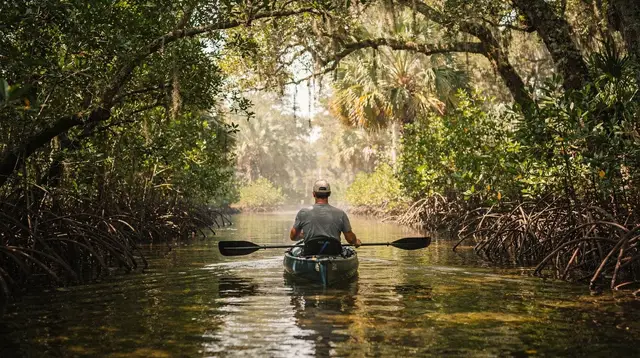
Florida springs day trip planner from Orlando
Which Florida spring should I visit on a day trip from Orlando?
Wekiwa Springs is the closest at 30 minutes and best for swimming. Blue Spring, 45 minutes away, is the winter manatee refuge (no swimming mid-November through March). Silver Springs and Rainbow Springs, both about 1 hour to 1 hour 30 minutes, suit glass-bottom boats and clear-water kayaking.
Picking a spring for the day
Central Florida has more first-magnitude springs than most visitors ever hear about, and they solve a real problem: a break from asphalt, lines, and air conditioning, at a fraction of a theme park’s cost. The catch is that the good ones fill up, and the rules are stricter than a public beach. This page compares the five springs that work as a day trip from Orlando — Wekiwa Springs, Blue Spring, Silver Springs, Rainbow Springs, and Alexander Springs — so you can pick one before you leave the house, and have a second choice ready.
None of these is a theme park. There’s no ticketed queue, no app to check wait times, and often no cell signal once you’re past the gate. What there is: water that holds at 72 F (22 C) all year, a spring run lined with cypress and oak, and, depending on the season, a real chance of seeing manatees, alligators, or turtles from a few feet away.
The five springs compared
| Spring | Drive from Orlando | Best activity | Best season |
|---|---|---|---|
| Wekiwa Springs State Park | 30 minutes | Swimming, short kayak on the Wekiva River | Year-round; best on weekdays |
| Blue Spring State Park | 45 minutes | Manatee viewing (winter); swimming (warm months) | Mid-November to March for manatees; April to October for swimming |
| Silver Springs State Park | 1 hour to 1 hour 15 | Glass-bottom boat, kayak, wildlife viewing | Year-round; mornings are calmer |
| Rainbow Springs State Park | 1 hour 15 to 1 hour 30 | Swimming, tubing, kayak on the Rainbow River | Spring through fall |
| Alexander Springs (Ocala National Forest) | 1 hour to 1 hour 15 | Swimming, snorkeling, quiet trails | Year-round; least crowded of the five |
Drive times assume a start in the Orlando theme park corridor; add 10 to 15 minutes from Kissimmee.
Wekiwa Springs State Park — the closest option
At about 30 minutes north of Orlando, Wekiwa Springs is the easiest spring to reach for a half-day. The spring pool itself is compact and popular for swimming, with a sandy-bottomed basin fed by a spring that pushes out roughly 42 million gallons a day. Beyond the swimming area, the Wekiva River offers a short, easy kayak run through cypress-lined water — a gentler introduction than the longer paddles covered in our Wekiwa Springs kayak guide.
Because it’s the closest spring to Orlando, Wekiwa also fills fastest. On a warm weekend, expect the gate to close to new vehicles by mid-morning. A weekday visit, or an arrival right at opening, is the reliable way in.
Blue Spring State Park — manatees change everything
Blue Spring, near Orange City about 45 minutes from Orlando, runs on two very different calendars. From mid-November through March, it’s the region’s best-known winter manatee refuge: as the St. Johns River cools, manatees move into the spring run, where the water holds steady at 72 F, and on a cold morning several hundred can gather at once. During this window, swimming in the spring run is closed — you watch from the boardwalk that follows the run’s edge, and it’s one of the most reliable wildlife sightings on this whole coast. For the full seasonal pattern, see our manatee season month-by-month guide and the Blue Spring viewing guide.
From April through October, the manatees move back out to the open river, the swimming ban lifts, and Blue Spring works as a conventional springs swim, with a clear, cold pool and a short trail along the run.
Silver Springs State Park — the glass-bottom boat, plus paddling
Silver Springs, on the edge of Ocala, is Florida’s original tourist spring: glass-bottom boats have run here since 1878, making it one of the oldest continuously operating tourist attractions in the state. The boat tour is the easiest way to see the spring’s wildlife without getting in the water, gliding over a series of spring vents in water so clear the bottom looks a few feet away when it’s actually twenty or thirty. Along the Silver River, look for the rhesus macaques that have lived wild here since the 1930s — descendants of monkeys released for an old jungle-boat attraction, not a natural population, and a detail every guide should mention rather than gloss over.
For a closer look, kayaking and clear-kayak tours put you on the water rather than above it:
For the boat-tour classic paired with a guided paddle, a guided kayak trip on the Silver River that looks for manatees and other wildlife covers both in one outing. For a see-through view of the spring vents from the water’s surface, a clear-bottom kayak tour over the Silver Springs vents is the better pick if photos matter more than distance covered.
At about 1 hour to 1 hour 15 from Orlando, Silver Springs pairs well with Ocala or a springs-focused day that skips the theme park corridor entirely.
Rainbow Springs State Park — swimming, tubing, and a longer paddle
Rainbow Springs, near Dunnellon and about 1 hour 15 to 1 hour 30 from Orlando, is Florida’s fourth-largest spring and one of the most scenic. The state park side has a terraced swimming area (built from an old roadside-attraction landscape, with waterfalls that are entirely artificial but pleasant nonetheless), while the Rainbow River itself is the draw for tubing and kayaking — clear, spring-fed, and lined with sandbars.
A guided option worth booking ahead: a guided eco-tour of Rainbow Springs that explains the spring system and its wildlife. For a paddle-focused outing that includes snorkeling stops, a clear-kayak and snorkel tour on the Rainbow River combines both in a single guided trip. And for a shorter, more accessible clear-kayak option closer to Dunnellon itself, a guided clear-kayak tour on Rainbow Springs near Dunnellon is worth checking for availability.
This page won’t walk through the river’s put-in points or paddle routes in detail — that’s covered fully in the Rainbow River paddle day guide.
Alexander Springs — the quiet fifth option
Tucked inside the Ocala National Forest, Alexander Springs is the least crowded of the five and the best backup when the others fill. It’s a genuine swimming hole with excellent visibility, popular with certified divers for shallow cavern dives, and it has a short nature trail that rarely sees a crowd even on a busy weekend. At roughly 1 hour to 1 hour 15 from Orlando, it sits close enough to work as either a primary destination or the fallback plan described below.
Alligators, wildlife, and staying safe in the water
Florida springs sit inside genuine wetland ecosystems, and alligators are part of that picture, even where swimming is allowed. State parks manage the swimming areas actively and close them if an alligator is spotted nearby, but the spring run and river beyond the roped-off zone are wild water, not a managed pool. The practical rule is simple: swim only inside the marked and monitored area, never in the open river or run at dusk or after dark, and keep small children and pets within arm’s reach rather than letting them wander toward the reeds at the edge. Kayakers on the Wekiva, Silver, or Rainbow rivers should give any alligator a wide, unhurried berth rather than paddling closer for a photo. For the fuller set of rules — including how to read a park’s posted signage and what to do if you do see one nearby — see our alligator safety guide for kayaking in Florida.
What to bring for a springs day
A springs day rewards a bit of preparation, since these are state parks with limited concessions, not resort pools with a poolside bar. Water shoes help on the rocky or root-covered entry points at Rainbow and Alexander Springs; a dry bag keeps phones and car keys safe on any of the kayak trips. Sunscreen matters more than it seems it should under the tree canopy, since reflection off clear water adds to the burn. Bring cash or a card for the vehicle entry fee, and arrive with a full tank of gas — several of these parks, especially Alexander Springs inside the Ocala National Forest, are well outside cell coverage and far from the nearest gas station.
Rules that apply at every spring
A few rules repeat across Florida’s state park springs, and knowing them before you arrive saves a wasted trip:
- Entry is per vehicle, not per person. Expect around 6 USD per car, paid at the gate — one of the best-value outings in the region for a family.
- Daily quotas exist, and gates close early. Each park caps the number of vehicles allowed in at once. On weekends, holidays, and spring break weeks, that cap is often reached before 10 a.m., and the gate simply closes to new arrivals until someone leaves.
- Styrofoam and alcohol are banned at most of these parks. Coolers are fine; foam cups and containers, and any alcohol, are not, and rangers do check.
- The water is a constant 72 F (22 C) year-round. That’s colder than expected in August and warmer than expected in January — pack a rash guard or light wetsuit top if you run cold, whatever the season.
- Manatee-season closures override the swimming schedule. Blue Spring is the clearest example, but check current signage at any spring between November and March; a run that’s normally open to swimmers can close temporarily if manatees move in.
The mistake: no backup plan on a spring Sunday
The single most common planning error is heading out on a spring weekend with one spring in mind and no alternative. Wekiwa Springs and Blue Spring, being the closest to Orlando, are also the first to hit capacity — on a warm Sunday in March or April, both can show a closed gate before 10 a.m., leaving a carload of disappointed swimmers with nowhere to go but back to the highway.
The fix is simple: decide on a first and second choice before leaving, ideally one closer (Wekiwa or Blue Spring) and one farther but larger (Silver Springs or Rainbow Springs), and leave early enough that arriving at 9 a.m. is realistic. If both primary options are full, Alexander Springs, being less well known, is the most reliable fallback of the five.
Building this into a longer day
A springs visit pairs naturally with the rest of the St. Johns River area — De Leon Springs for pancakes cooked at the table, or Ocala for a base near both Silver Springs and Rainbow Springs. For travelers weighing a dedicated springs-and-wildlife stretch rather than a single day, the central Florida springs and wildlife itinerary lays out a multi-day version, and the Florida springs day trip planner approach here scales down to a single day trip from the Orlando parks corridor. A shorter two-day version, pairing a springs day with the rest of the St. Johns River area, is covered in the two-day springs and St. Johns River itinerary.
Driving yourself is close to essential for this trip — none of these five springs sits on a transit line, and a rental car is the practical way to string two of them together in one day. If you’re weighing whether to rent at all for the wider trip, our guide to renting a car in central Florida covers the tradeoffs.
If manatees are the real goal rather than swimming, compare this page against Crystal River, the only place in the country where swimming with manatees is legal, covered in the Crystal River manatee swim guide — a longer drive at 1 hour 45 minutes, but a different experience entirely from the springs above.
Frequently asked questions about visiting Florida springs from Orlando
Which spring is closest to Orlando?
Wekiwa Springs State Park, about 30 minutes north of Orlando, is the nearest option and works well for a half-day swim or a short kayak on the Wekiva River.
Can I swim in Blue Spring in winter?
No. From mid-November through March, Blue Spring closes to swimmers because manatees gather there in the hundreds. You can still walk the boardwalk and watch them, but the water itself is off-limits.
Do Florida springs charge per person or per car?
Florida state park springs charge around 6 USD per vehicle, not per person, which makes a family day trip one of the cheapest outings in the region.
How cold is the water at Florida springs?
Springs hold a constant 72 F (22 C) year-round, which feels cool in summer and surprisingly warm in winter compared to the air temperature.
Do state park springs sell out?
Yes. Popular springs cap daily entry and close the gate once the lot is full, often before 10 a.m. on weekends, holidays, and spring weekends in particular.
Can I bring a cooler or alcohol to a springs park?
Styrofoam containers and alcohol are banned at most Florida state park springs, and rules are enforced at the gate and by rangers on site.
Is Silver Springs good for kayaking or just the boat tour?
Both. The glass-bottom boat tour is the classic way to see Silver Springs, but kayaking and paddleboarding on the Silver River are also available and get you closer to the wildlife.
What’s the backup plan if a spring is full?
Have a second and third spring in mind before you leave Orlando, since Wekiwa and Blue Spring in particular can fill by mid-morning on a busy Sunday.
Are there alligators in Florida springs?
Yes, alligators live in the rivers and runs connected to these springs, though the marked swimming areas are actively managed. Stay inside the roped-off swim zone, keep an eye on kids near the water’s edge, and see our alligator safety guide before a kayak trip on any of these rivers.
Natural springs and state park tours on GetYourGuide
Verified deep-linked GetYourGuide tours. Book through these links and we earn a small commission at no cost to you.
GetYourGuide does not provide a product photo for this activity — the image shows the meeting point, photographed by us.