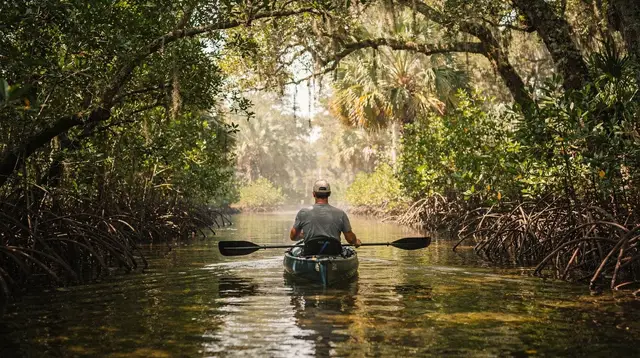
Alligator safety for kayaking and paddling in Florida
Is it safe to kayak in Central Florida with alligators around?
Yes, with basic rules: stay off unmonitored shorelines at dawn and dusk, keep hands and pets inside the boat, never feed or approach an animal, and treat every freshwater lake, canal, or river as alligator habitat, including ones inside subdivisions.
The one fact that changes how you plan a paddle
Alligators live in almost every body of freshwater in Central Florida. Not just the springs and the Wekiva River and the marshes around Kissimmee — lakes, drainage canals, golf course ponds, and the retention ponds behind hotel parking lots too. There is no separate category of “safe” suburban water and “wild” alligator water. A pond with a manicured edge and a fountain in the middle can hold an alligator the same as a cypress-lined stretch of the St. Johns River. The absence of a warning sign means nothing; plenty of ponds that hold alligators are never posted, because the county doesn’t post every water body, only the ones with a documented history of conflict.
That single fact should shape three decisions before anyone puts a paddle in the water: where you launch, where you land, and what your kids and dog do while gear comes out of the car. Get those three right and the actual paddling is low-risk. Get them wrong at the shoreline — which is where nearly every documented incident happens — and the risk jumps.
This guide covers hand-launched paddling: kayaks, canoes, and paddleboards on lakes, rivers, springs, and canals. It does not cover airboat tours or animal encounter parks, which are a different activity with guides, engines, and controlled distance — see our airboat guide and our comparison of seeing alligators by boat versus at a park for those.
How alligators actually behave around paddlers
An alligator’s default response to a kayak is to avoid it. On open water, a paddler reads as too large and unfamiliar to treat as prey, and most alligators submerge or move off well before a boat gets close. That is why the water itself is not where problems start. The water’s edge is.
Alligators are ambush predators that rely on surprise, and the shoreline — with its cover of reeds, fallen logs, and overhanging brush — is where they wait and where they defend territory. A hand or a paddle blade trailing in the water near a bank, a dog sniffing along the reeds, a bare foot stepping off a kayak onto muddy grass: these are the situations that put a person within an alligator’s strike range, not the act of paddling across a lake.
Three behavioral windows matter for planning:
Dawn and dusk. Alligators are most active feeding around sunrise and sunset, and feed through the night. A sunset paddle that’s timed to finish after dark, or a dawn launch before full daylight, puts you on the water during the hours alligators are hunting rather than basking. It isn’t a reason to skip an evening paddle — sunset on a Florida lake is one of the better reasons to be out there — but it argues for staying mid-channel and away from the banks as the light fades, rather than drifting close to shore to look at wildlife.
Spring mating and nesting season, roughly April through June. Males patrol territory more aggressively and cover more distance during mating season, and females build nests of vegetation near the shoreline in early summer and defend them fiercely until hatching in late August or September. A nest is a fixed hazard: the same stretch of bank an alligator ignored in February can be actively defended in June. This is the single biggest seasonal shift in risk, and it is also, not coincidentally, when the state records the most incidents.
Cold snaps. Alligators are reptiles and go dormant, or close to it, in cold weather. A cold front pushing temperatures down in December or January genuinely lowers activity — but Central Florida’s winters are short and mild, with days back in the 20s Celsius within a week, so this is a minor factor, not a season to rely on.
The rules that actually reduce risk
Most alligator-related incidents in Florida trace back to a short list of preventable moments, not bad luck. In order of how often they matter:
Keep hands, feet, and paddles inside the kayak near the banks. This is the single most important rule. An alligator lunging from cover is reacting to something at or below the waterline within its strike range, which is roughly its own body length. A trailing hand or a paddle blade dragged along a reedy edge is exactly that kind of target.
Never feed an alligator, ever, for any reason. Feeding is illegal in Florida and it is also the direct cause of the behavior everyone is trying to avoid: an alligator that loses its natural wariness of people and starts approaching boats and shorelines expecting food. Florida wildlife officers trace a large share of “aggressive” alligators back to a history of being fed, deliberately or by someone leaving food scraps at a dock.
Don’t land on a shoreline you can’t see into. A clean, open beach or a maintained boat ramp is fine. A tangled, reed-choked, or overgrown bank is where alligators rest and where nests get built in early summer. If you need to get out — to stretch, to scout a portage, to let a dog out — pick a spot with a clear sightline first, and look before stepping.
Keep dogs in the boat, not swimming alongside or loose on the bank. A dog paddling next to a kayak, or off-leash sniffing the shoreline while gear gets loaded or unloaded, is the classic setup for a pet-related incident. Dogs read as prey-sized in a way people generally don’t. If a dog is coming along, it rides in the kayak, and it stays leashed and close during launch and landing.
Watch kids at the water’s edge, always, even on a “safe” lake. The riskiest ten minutes of any paddling trip are often the ones before and after the water, when kayaks get carried down to a launch and kids wander to the shoreline to wait. Treat that time with the same attention as the paddle itself, especially on lakes inside resorts and subdivisions that look landscaped and tame.
Give a basking alligator a wide, calm berth. An alligator sunning itself on a bank is not a threat if left alone. Don’t paddle in for a closer look, don’t circle it, and don’t linger. Keep moving at a normal pace and put distance between the kayak and the bank.
Other water hazards worth knowing
Alligators get the headline, but two other risks are worth a paragraph each, because they’re easy to prevent and easy to misjudge.
Cottonmouths and other water snakes. The venomous water moccasin, or cottonmouth, shares the same banks, fallen logs, and overhanging branches as alligators across Central Florida’s lakes and rivers. Like alligators, they are not aggressive toward passing boats and most bites happen when someone reaches into brush, lifts a log, or handles a snake directly. The same discipline applies: don’t put a hand into vegetation or under a log from the kayak or on the bank, and give any snake sunning on a branch room to be left alone.
Naegleria fowleri, the so-called brain-eating amoeba. This organism lives naturally in warm, stagnant freshwater across the southern United States, including some Florida lakes and slow-moving canals, particularly in summer. It is rare and it is not a paddling risk in the ordinary sense — it only causes harm if water is forced forcefully up the nose, which means the real exposure is jumping or diving into warm, still water, or letting kids dunk their heads repeatedly in a stagnant pond. It is not a reason to avoid a kayak trip; it is a reason to avoid jumping into warm, standing water and to favor flowing spring runs over stagnant ponds for any swimming.
Where this actually plays out: the suburban-lake trap
The mistake that catches out visitors more than any other is judging a lake by how it looks rather than what it is. A landscaped pond behind a vacation rental near Kissimmee, a retention lake inside an International Drive resort, or a canal running behind a row of townhomes reads as tame: mowed grass to the edge, a walking path, maybe a fountain aerator in the middle. None of that indicates the water is alligator-free — aerated retention ponds and canals are ordinary alligator habitat, and Florida’s wildlife agency fields far more calls about alligators in exactly this kind of managed, suburban water than in remote wilderness.
The specific failure pattern: a family unloads kayaks at a community dock, and while one adult carries gear back and forth, a child wades at the water’s edge or a dog is let off-leash to explore the bank. Nobody sees a sign, nobody has seen an alligator on this lake before, and the ten minutes of loading feels like the safe part of the trip compared to the paddle itself. It’s the reverse of the actual risk profile. Treat every lake launch — landscaped or wild — with the same edge discipline: kids and dogs stay back from the waterline until everyone is in the boat and ready to go.
Popular paddling spots around Orlando, and what changes with each one
Not every stretch of water carries the same alligator profile, and knowing the difference helps with planning rather than just caution.
Spring runs like the one covered in our Wekiwa Springs kayak guide, and the wider routes in our Florida springs day trip planner, run cold and clear year-round — Florida’s springs hold a steady 22°C twelve months a year — and the current keeps paddlers moving rather than drifting close to a bank, which is part of why a spring run feels calmer than a still lake even though alligators use spring-fed rivers too.
Blue Spring, covered in our manatee viewing guide, draws its crowds for manatees rather than alligators, but the same edge rules from above still apply at the launch and around the swim area.
Further west, Crystal River — inside the destination of the same name, Crystal River, and detailed in our manatee swim guide — is a saltwater and spring-fed system where manatee etiquette (see our manatee encounter rules guide) matters more day to day than alligator risk, though the freshwater stretches feeding into it still hold alligators and deserve the same shoreline caution.
South of the springs corridor, the Rainbow River near Ocala, detailed in our Rainbow River paddle guide, is another spring-fed run with the same clear, cool water and the same edge discipline at its launch points.
For something different after dark, the bioluminescent kayak tours on the Mosquito Lagoon run on brackish coastal water rather than a freshwater lake, which changes the wildlife mix — but any paddle timed for after dark still calls for the same distance from the banks described above. A guided, lower-effort alternative that skips the paddling altogether is the St. Johns River eco-cruise, which covers much of the same water from a boat.
Quick reference
| Situation | What to do |
|---|---|
| Paddling open water, no alligator visible | Normal paddling; low risk |
| Alligator basking on a bank | Keep distance, keep moving, don’t approach |
| Approaching a reedy or overgrown shoreline | Keep hands and paddle blade inside the kayak |
| Launching or landing at any dock or bank | Keep kids and dogs back until everyone is in or out of the boat |
| Dawn, dusk, or after dark near a shoreline | Stay mid-channel, extra distance from banks |
| April through June (nesting season) | Extra caution on any bank with visible vegetation piles |
| Warm, stagnant pond or canal | Avoid jumping or dunking your head; fine for paddling |
| Snake sunning on a branch or log | Leave it alone, don’t reach into brush from the kayak |
Guided options if you’d rather not plan the route yourself
A guide who knows the specific stretch of water removes most of the guesswork above, since they already know which banks nest in summer and where the current run is calm enough for beginners. The Orlando kayaking tour that combines a guided paddle with a manatee encounter keeps a naturalist on the water with you the whole time. For a calmer, more scenic introduction, the sunset kayak tour with a guide times the paddle to daylight before the evening feeding window rather than after it. Families who want to see alligators up close without paddling near them at all might prefer the Wild Florida kayak tour on the Dora Canal, run with an experienced local outfitter. For a longer day on quieter water, the Econlockhatchee River day trip from Orlando covers a shaded, spring-fed run with a guide who reads the banks for you.
Alligator and water safety while kayaking in Florida
Are there alligators in every lake in Central Florida?
Assume yes. Alligators live in almost every freshwater lake, canal, retention pond, and river in the region, including small ponds inside housing developments and golf courses. The absence of a warning sign does not mean the absence of an animal.
Will an alligator attack a kayak?
It is rare. Alligators generally avoid boats and retreat when a kayak approaches, since a paddler on the water reads as too large to be prey. Incidents cluster around the water’s edge, not open water, which is why hands and paddles staying inside the kayak matters more than the paddling itself.
When are alligators most active?
Spring, roughly April through June, is mating and nesting season, when males patrol territory and females defend nests near the shoreline. Alligators are also more active at dawn and dusk year-round, and they feed after dark, so evening paddles need extra distance from the banks.
What should I do if I see an alligator while paddling?
Keep paddling calmly and keep your distance. Do not approach for a photo, do not follow it, and do not stop to watch from close range. An alligator that submerges nearby has usually just moved off; there is no need to change course dramatically or panic.
Is it safe to bring a dog kayaking in Florida?
A dog can ride in the kayak, but should not swim alongside it or be left at the water’s edge while you load and unload gear. Dogs read as prey-sized to an alligator, and most bank-side incidents involving pets happen during exactly that unloading window, not during the paddle itself.
What is the brain-eating amoeba risk in Florida springs and lakes?
Naegleria fowleri is a rare but serious risk in warm, stagnant freshwater, particularly in summer. It only causes harm if water is forced up the nose, so it is a concern for jumping, diving, or dunking your head in warm, still water, not for sitting in a kayak or a flowing spring run.
Are water moccasins a real concern for paddlers?
Cottonmouths, Florida’s venomous water snake, live along the same banks and fallen logs as alligators. They are not aggressive toward boats and rarely bite unless handled, so the same rule applies: don’t reach into brush, logs, or overhanging branches from the kayak or on the bank.
Kayak and paddleboard tours on springs and rivers on GetYourGuide
Verified deep-linked GetYourGuide tours. Book through these links and we earn a small commission at no cost to you.
GetYourGuide does not provide a product photo for this activity — the image shows the meeting point, photographed by us.