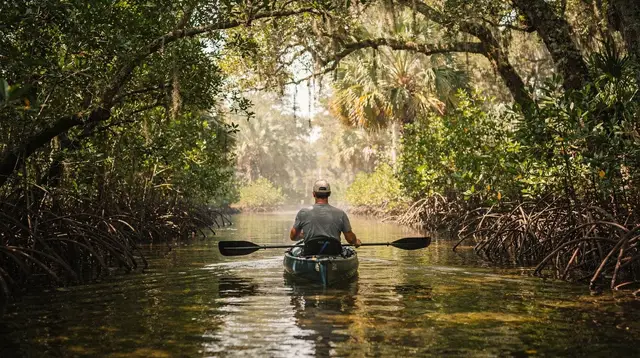
Kayaking Wekiwa Springs and the Rock Springs Run
What is kayaking the Rock Springs Run near Orlando actually like?
It's a shallow, spring-fed run out of Kings Landing or Wekiwa Springs State Park, about 30 minutes from Orlando, with water near 22 C year-round, a gentle current, and turtles, wading birds, and occasional alligators along the banks. Most trips run two to four hours depending on the route and whether you arrange a shuttle.
The Rock Springs Run is the paddle most people mean when they say they want to kayak a Florida spring near Orlando. The put-in is about 30 minutes north of downtown, the water runs a constant 22 C (72 F) whatever the month, and the current is slow enough that the trip is really about looking down into clear water and up into overhanging trees rather than working hard to get anywhere. It sits at the edge of the St. Johns River spring system, close enough to Orlando for a half-day trip, far enough into the woods to feel like a different state entirely.
This guide covers Wekiwa Springs State Park and the Rock Springs Run specifically: the route, the logistics of getting a boat and getting back to your car, what lives in the water and on the banks, and the one mistake that ruins more trips here than anything else — arriving too late on a weekend. It does not cover the spring-fed rivers around Ocala or tubing, which have their own pages; see Rainbow River paddling and the broader Florida springs day trip planner for those.
The run itself
Rock Springs pushes out of the ground at Kelly Park / Kings Landing at a steady 22 C and flows a little over eight kilometers (five miles) before it widens into Wekiwa Springs State Park and eventually the Wekiva River. The water is shallow — often under a meter (a few feet) — and startlingly clear over a sand and limestone bed, which is most of the appeal: you can watch fish and turtles from directly above them rather than guessing at shapes in tannic water.
The current is mild, noticeably faster near the spring head at Kings Landing and gentler as the run widens downstream. Paddling downstream from Kings Landing to Wekiwa Springs State Park with the current is the standard trip; going the other direction, against the flow, is slower and not what most first-timers should plan for. The banks alternate between open sandy stretches and dense overhanging cypress and oak, so expect long shaded sections along with a few open ones where the sun is direct.
Wildlife is close and frequent rather than a matter of luck. River turtles line up on half-submerged logs in numbers that surprise most first-time visitors. Wading birds — herons, egrets, wood storks, the occasional limpkin — work the shallows. Alligators are present in the run and are seen regularly sunning on the banks or half-submerged near the edges; a sighting is common but never guaranteed, and should never be treated as part of a package. Keep the kayak or paddleboard between you and any alligator you spot, and never approach one for a photo — see alligator safety while kayaking for the specifics.
Getting there from Orlando
Both access points sit north of the city, reachable in well under an hour from most Orlando bases without needing to touch the interstate for most of the drive. Kings Landing and Wekiwa Springs State Park are a short distance apart, so the drive itself isn’t a factor in choosing which one to use — the deciding factor is capacity and whether you want a shuttle. If you’re driving in from International Drive or the parks corridor, expect to cross some of the same corridors covered in driving the I-4 and Florida traffic, though this trip stays mostly off the interstate once you’re north of the city. Anyone still deciding whether to rent a car for the trip at all should see renting a car in central Florida — a spring run this far from the parks corridor is one of the clearer cases for having your own vehicle rather than relying on ride-hailing both ways.
Parking is on-site at both Kings Landing and Wekiwa Springs State Park and is included with the entrance or rental fee; it fills at the same rate the gate does; on a busy weekend, no parking spot open also usually means the vehicle cap has been reached and the gate is closed to new arrivals.
Logistics: launch points, shuttles, and timing
There are two main access points, and knowing the difference matters for planning:
| Access point | What it offers | Typical use |
|---|---|---|
| Kings Landing (Kelly Park) | Kayak, canoe, and paddleboard rental; shuttle service upstream | Put in near the spring head, paddle downstream with the current |
| Wekiwa Springs State Park | Spring swimming area, canoe/kayak launch, hiking trails | Take-out point for the Kings Landing run, or a shorter round-trip paddle on its own |
Most paddlers rent from Kings Landing, take a shuttle van a short distance upstream, and paddle back down to their car — that way the current works in your favor the entire trip and there’s no need to arrange a separate vehicle drop. Bringing your own kayak also works; some visitors leave a second car at the Wekiwa Springs State Park take-out and shuttle themselves, though this takes more coordination than renting on-site.
Trip length runs roughly two to four hours depending on the exact route, how much time you spend stopped for wildlife, and whether you do the full run or a shorter loop closer to Kings Landing. Two to three hours is typical for the main downstream run at an unhurried pace; add time if you’re paddling with young children or stopping often to look at turtles and birds.
Arrive early — this is the one rule that matters
Wekiwa Springs State Park, like most Florida state parks, caps the number of vehicles allowed inside at once and closes the entrance gate once that capacity is reached. On a spring weekend — March through May especially, plus any long holiday weekend — that limit can be hit before mid-morning. Kings Landing operates on its own capacity and can fill separately.
The failure mode is specific and avoidable: arriving around eleven on a Saturday in March expecting to improvise, finding the gate closed or the outfitter fully booked, and turning what should have been a half-day paddle into two hours of driving for nothing. Arrive at or before opening, especially on a weekend, and book any rental or shuttle in advance rather than assuming a walk-up spot. Weekday mornings are far more forgiving if your schedule allows it.
What to bring
- Closed-toe water shoes. Launch points and some banks are sandy but can also have roots and shell fragments; sandals slip and flip-flops are close to useless getting in and out of a kayak.
- A dry bag. For phone, keys, and anything else that shouldn’t get wet if the boat tips or a wake splashes in.
- Sun protection. Reef-safe sunscreen, a hat, and sunglasses — long stretches of the run are open to full sun with no shade at all.
- Water. More than feels necessary. There’s no vendor once you’re on the water, and Florida heat plus paddling effort adds up faster than it seems.
- No dependence on cell signal. Coverage is inconsistent to nonexistent along much of the Rock Springs Run, particularly in the wooded middle stretch. Download any confirmation numbers, maps, or directions before you launch, and let someone onshore know roughly when you expect to be back.
Is this trip right for kids, beginners, and non-swimmers?
The current is gentle enough that the downstream run from Kings Landing is a reasonable first kayak trip for most healthy adults and older kids, and the shallow, clear water makes it easy to see what’s ahead rather than paddling blind. That said, it isn’t a lazy-river float: a kayak still needs to be steered around fallen branches and the occasional narrow, faster stretch near the spring head, and a capsize means getting back into a boat in moving water rather than on a still lake. Families traveling with toddlers or preschoolers who want water time without the paddling logistics are usually better served by a spring swimming area or a flatter lake trip — see Orlando with toddlers and preschoolers for age-appropriate alternatives, and accessible Orlando: mobility and sensory if mobility is a factor in choosing a launch point. A life jacket is worth wearing regardless of swimming ability; the water is shallow in most places but the current and submerged roots are real.
If the park is full
Kings Landing and Wekiwa Springs State Park are separate entrances with separate capacity limits, so one filling up doesn’t automatically mean the other is closed — it’s worth checking both before giving up on the day. If both are at capacity, the honest answer is that there’s no same-day substitute close by that replicates this exact run. Rainbow Springs, further out near Ocala, offers a comparable clear-water paddle (see the Rainbow River paddle guide), and Alexander Springs in the Ocala National Forest is another option, but both are a real drive from Orlando rather than a quick pivot. This is exactly why the early arrival rule matters more here than at almost any other stop on this site.
Nearby paddling for comparison
Rock Springs Run isn’t the only spring-fed paddle within reach of Orlando, and it isn’t interchangeable with the others. For a shorter, calmer, lake-based outing closer to the city, see the Orlando cable parks and lake watersports guide. For a trip built specifically around seeing manatees rather than turtles and birds, Blue Spring manatee viewing covers the winter congregation further north, and the general manatee tour boat versus kayak comparison explains when a guided kayak trip beats a boat tour. If bioluminescence rather than clear-water wildlife is the draw, that’s a summer, coastal, and entirely different trip — see bioluminescent kayak on the Mosquito Lagoon.
For paddlers who’d rather not manage rental logistics, shuttle timing, and gate quotas themselves, a guided guided kayak trip down the Rock Springs Run with a picnic lunch included handles the shuttle and timing questions directly. For a different setting on the same clock, a guided sunset kayak outing on Orlando’s chain of lakes trades the spring current for open water and evening light. Families or groups who want a flatter, easier paddle closer to the city might prefer a paddle board or kayak outing on Lake Conway, and paddlers hoping to combine wildlife-watching with a guided route can look at a kayak tour built around a manatee encounter as a seasonal alternative to the Rock Springs Run.
Planning the rest of the day
The run sits close enough to central Orlando that it pairs easily with other things to do in the area without eating an entire vacation day. Winter Park is about 30 minutes south for lunch or a walk along Park Avenue, and Ocala and the wider spring system are within range if the plan is a full springs day trip rather than a single stop. Anyone building out a longer itinerary around water-based days should also check the two-day springs and St. Johns River itinerary, which sequences this run against nearby stops so the timing works rather than clashing with another park’s own quota.
Kayaking the Rock Springs Run: questions people ask
How cold is the water at Wekiwa Springs and the Rock Springs Run?
The spring runs at a steady 22 C (72 F) all year, so it feels cool in August and comparatively warm in January. Air temperature, not water temperature, is what changes with the season.
Do I need to book a shuttle, or can I paddle round trip?
Most paddlers put in at Kings Landing, ride a shuttle van upstream, and paddle back down the Rock Springs Run to their car, which takes the current out of the equation for the return leg. Paddling round trip against the current from Wekiwa Springs State Park is possible but slower and less common.
How early do I need to arrive on a weekend?
Aim to be at the gate at opening, especially March through May and on any holiday weekend. Wekiwa Springs State Park caps the number of vehicles allowed inside and closes the entrance once that limit is reached, often before mid-morning.
Will I see an alligator?
Alligators are present in the run and are seen fairly often sunning on the banks, but a sighting is never guaranteed and should never be promised. Stay in your kayak or on the marked swimming areas and keep a clear distance from any animal you do see.
Is there cell phone signal on the run?
Coverage is patchy to absent along stretches of the Rock Springs Run, particularly in the wooded middle section. Download any maps or confirmations before you put in and tell someone your expected return time.
What should I wear and bring?
Closed-toe water shoes for the sandy, sometimes root-covered banks and launch points, a dry bag for phone and keys, reef-safe sunscreen, and more drinking water than feels necessary, since much of the run has no shade.
How long does the paddle take?
Most one-way trips from Kings Landing down to Wekiwa Springs State Park run two to three hours at an easy pace; a full round trip or a longer combined route can run closer to four hours. Add time for wildlife stops, since the slow current does not reward rushing.
What if the park is full when I arrive?
Kings Landing on the Rock Springs Run has its own launch and is a separate entrance from Wekiwa Springs State Park, so one filling up does not always mean the other is closed. If both are at capacity, Rainbow Springs and Alexander Springs are within driving range for a similar spring-fed paddle, though neither is a same-day substitute once most of the morning is gone.
Is Rock Springs Run suitable for beginners and kids?
The downstream trip from Kings Landing is manageable for most first-time paddlers and older kids thanks to the mild current and shallow, clear water, but it isn’t a still-water float — expect some steering around fallen branches and a faster stretch near the spring head. A life jacket is worth wearing regardless of swimming ability, and families with toddlers or preschoolers are usually better off with a flatter, land-based water option instead.
Do I need to book in advance, or can I show up and rent a kayak?
Book ahead whenever possible, especially for weekends and school holidays. Kings Landing’s rental and shuttle service can sell out by mid-morning on a busy Saturday even before the vehicle cap closes the gate, and a booked reservation guarantees a boat where a walk-up does not.
Kayak and paddleboard tours on springs and rivers on GetYourGuide
Verified deep-linked GetYourGuide tours. Book through these links and we earn a small commission at no cost to you.
GetYourGuide does not provide a product photo for this activity — the image shows the meeting point, photographed by us.