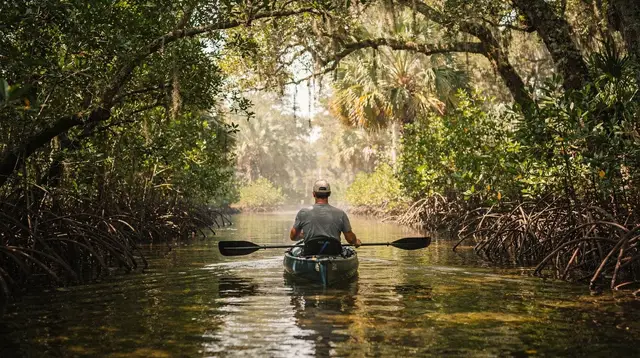
Kayaking to Caladesi Island and Honeymoon Island
How do you kayak to Caladesi Island from Honeymoon Island?
A marked paddle trail runs through the lagoon on the back (bay) side of Honeymoon Island State Park to Caladesi Island State Park, about one hour of paddling each way. There is no store on the water, so bring everything before launching, and check wind before committing to the crossing.
Two barrier islands sit just north of Clearwater Beach, and one of them, Caladesi Island, can only be reached by boat, ferry, or paddle. That’s the draw. No causeway, no parking lot on the sand, no beach bar within walking distance of the shoreline. A marked kayak trail connects the two parks through a shallow lagoon on the bay side, and paddling it is a different experience from anything the theme park corridor offers: quiet water, grass flats, and a beach at the end that most visitors only see from a ferry rail.
The route and what’s on it
Honeymoon Island State Park and Caladesi Island State Park sit end to end, separated by a narrow pass called Hurricane Pass. The paddle trail runs on the landward (bay) side of both islands, through Saint Joseph Sound, not along the open Gulf beach. That distinction matters: the Gulf side has real surf and swell on a windy day, while the lagoon side is sheltered by the islands themselves and stays comparatively calm in normal conditions.
Launch from the designated kayak launch on Honeymoon Island’s north end, follow the marked trail south along the mangrove and grass-flat edge, cross the mouth of Hurricane Pass, and land on Caladesi Island’s bay-side beach near the ferry dock. From there it’s a short walk over to the Gulf-front beach, which regularly ranks among Florida’s better stretches of sand and is far less crowded than Clearwater Beach itself, simply because most people who see it arrived by ferry on a schedule rather than under their own power.
The water along most of the route is shallow, often just a meter or two deep over sand and turtle grass. That shallow water is exactly why the wildlife shows up close to the boat.
What you’ll actually see
- Rays. Cownose rays and southern stingrays glide over the grass flats in good numbers, often visible as shadows moving under the kayak before you spot the animal itself.
- Wading shorebirds. Herons, egrets, ibis, and willets work the mud and sand edges at low tide, unbothered by a kayak moving slowly past.
- Ospreys and pelicans overhead, fishing the same water you’re paddling through.
- Dolphins, more often toward the pass and the open water near the island tips than deep in the lagoon, but sightings are common enough that most paddlers see at least a fin on a given trip. Not guaranteed, and nobody running a trip here should promise one.
None of this is staged or fed. It’s simply what a shallow, protected estuary looks like when it isn’t dredged for boat traffic, and it’s the same reason paddlers heading south from Clearwater toward Sarasota describe similar mangrove-edge wildlife on the mangrove tunnel paddle near Sarasota.
Clearwater Marine Aquarium, on the mainland side of town, runs a rescue and rehabilitation program for injured manatees, dolphins, and sea turtles, and pairs naturally with a paddling day built around the same wildlife theme — see the Clearwater Marine Aquarium visit guide for what’s involved.
Timing: about an hour each way
Budget roughly one hour of paddling per direction at a comfortable, unhurried pace. That’s water time only. Add time for parking, unloading or renting a kayak, using the restroom before launch (nothing past this point), and time on Caladesi’s beach itself, and a full round trip with a real stop on the island runs a half day rather than a couple of hours.
The one-hour figure assumes flat water and light wind. It stretches significantly if you’re paddling into a headwind on the return, which is the single most common reason a planned two-hour outing turns into four.
| Leg | Distance (approx.) | Time in calm conditions |
|---|---|---|
| Honeymoon Island launch to Hurricane Pass crossing | ~2 km | 25–30 min |
| Crossing to Caladesi Island landing | ~1 km | 15–20 min |
| Return (with wind against you) | same | 45–75 min |
Wind, not weather, decides the day
This is the fact that matters more than anything else on this page: wind, not sunshine, determines whether the crossing is easy or miserable. A forecast showing a clear, sunny day says nothing about wind speed or direction, and this stretch of Saint Joseph Sound is open enough that a sustained westerly can turn the return leg into a slog against both wind and wind-driven chop.
The mistake to avoid specifically: launching on a day with a strong sustained west wind because the sky looks perfect. A west wind blows straight up the sound from the open Gulf side, builds chop across the crossing, and turns what should be an easy hour-long paddle back into a fight, particularly for less experienced paddlers or anyone in a sit-on-top rental kayak that catches wind more than a sea kayak does. Check wind speed and direction, not just the weather icon, before committing. Under roughly 15 km/h (10 mph) and from the east or north, conditions are generally manageable for an average paddler. Above that, especially out of the west, consider the ferry instead, or shift the trip to early morning before the sea breeze builds.
Morning is the reliable answer to this problem. Central Florida’s Gulf coast tends to be calmest at first light, with onshore sea breezes typically building through late morning and peaking in the afternoon, especially in the warmer months. Launching early isn’t just pleasant, it’s the practical way to guarantee flat water for both directions of the trip rather than gambling on the return.
Wind behaves differently again during hurricane season, which runs June 1 through November 30 with the highest activity from August to October. A distant tropical system can push sustained wind and swell into Saint Joseph Sound well before any rain reaches the coast, so it’s worth checking the marine forecast specifically, not just the day’s weather icon, during those months. The hurricane season travel guide covers how that stretch of the calendar affects Gulf coast plans more broadly.
What to bring — there’s nothing to buy out there
Once you push off from Honeymoon Island’s bay side, there is no store, no snack stand, and no water fountain until you reach the small concession near Caladesi’s ferry dock. Pack as if nothing is available, because along the lagoon trail itself, nothing is:
- Drinking water, more than you think you need, in a container that won’t float away if it goes overboard
- Snacks or lunch, since dining options on Caladesi are limited to that one seasonal concession
- Reef-safe sunscreen and a hat, since there is zero shade on the open water
- A dry bag for phone, keys, and wallet
- Closed-toe water shoes for the shallow launch and landing, where oyster shell and grass can be sharp underfoot
- A whistle or other sound signal, and a life jacket for every paddler, which Florida law requires be carried in the boat
- A basic paddle map or the trail markers memorized in advance, since GPS on a phone isn’t a substitute for knowing which shoreline to follow at the pass
Getting there and entrance fees
Both parks are reached from the mainland via Dunedin, north of Clearwater. Honeymoon Island State Park has its own causeway and entrance; Caladesi Island State Park’s only mainland access point is a separate ferry departure a few kilometers south, since the island itself has no bridge. For the paddle route described here, you only need the Honeymoon Island entrance, since the kayak launch and the whole trail depart from there.
Entrance runs around 8 USD per vehicle at the gate, plus tax, paid once at Honeymoon Island; no additional fee applies for paddling the trail or landing on Caladesi. If you don’t own a kayak, both self-guided rentals and guided kayaking trips out of Clearwater can supply boats, paddles, and life jackets, which removes the gear logistics for visitors traveling without their own equipment.
a guided kayak trip out of Clearwater with equipment included is the simplest way to do this route without hauling your own boat, and a guide who paddles the lagoon regularly also has a better read on the day’s wind than a first-time visitor checking a forecast app.
Neither park sits directly on a transit line, so renting a car for the Gulf coast portion of a Florida trip is close to essential for reaching Dunedin and the Honeymoon Island causeway from an Orlando base.
Other ways to be on this water
The lagoon trail isn’t the only way to get on the water around Clearwater. A clear-bottom kayak tour puts the grass flats and any passing rays directly under a transparent hull rather than beside the boat, which is a different way to see the same shallow water described above. For an evening on the water instead of a morning one, a LED clear kayak night tour runs after dark closer to Clearwater Beach itself, a shorter and more casual outing than the full Caladesi crossing.
Parking fills early — plan for it
Honeymoon Island’s lot fills by mid-morning on winter weekends and holidays, and once it’s full, the gate closes to new vehicles until space opens up. Arriving for an 8 or 9 a.m. launch solves two problems at once: it beats the parking crunch and it puts you on the water before the wind typically builds. Arriving at noon on a Saturday in January, expecting an easy walk-in launch, is a common and avoidable disappointment.
Who this trip suits, and who it doesn’t
This isn’t a trip for absolute beginners with no paddling experience at all, though it doesn’t require expert skill either. The distance is moderate, the water is normally calm, and the trail is marked, but a real open-water crossing at Hurricane Pass and the total round-trip time mean it asks more of a paddler than a short mangrove creek loop does. Families with older children who can paddle their own kayak or sit steady in a tandem generally do fine; very young children are better suited to a shorter, more sheltered outing, or to the ferry option instead of the paddle.
Paddlers who want the guaranteed dolphin sightings and hands-off logistics of a boat tour rather than a self-directed crossing should look at Clearwater’s dolphin cruise options instead, which cover the same general waters from a larger boat, or compare dolphin cruise versus swim programs if a closer encounter is the goal. For alligator-related paddling questions specific to Florida’s freshwater systems, that’s a separate topic covered in the kayaking alligator safety guide — this lagoon is brackish coastal water, and alligators are not the relevant wildlife concern here; rays and boat traffic near the pass are. Visitors who’d rather add speed than distance can look at jet ski and parasailing options elsewhere on the Gulf coast instead.
If a longer coastal paddling day appeals, the trail networks around Gulf beach paddleboarding, Gulf beach bike rides, and the mangrove tunnels near Sarasota extend the same idea, shallow, sheltered, wildlife-rich water, further down the coast, and pair naturally with a Clearwater base for a Gulf coast stretch of a longer Florida trip.
Paddlers building a full Gulf coast week around Clearwater often add St. Petersburg and its museums, Tampa and Ybor City, or Sarasota and Siesta Key to the same trip — a shape covered in three days from Orlando to Tampa and the Gulf and in the longer seven days across Orlando parks and Gulf beaches itineraries.
Kayaking to Caladesi Island: frequently asked details
How do you kayak to Caladesi Island from Honeymoon Island?
A marked paddle trail runs through the lagoon on the back (bay) side of Honeymoon Island State Park to Caladesi Island State Park, about one hour of paddling each way. There is no store on the water, so bring everything before launching, and check wind before committing to the crossing.
How long does the paddle to Caladesi Island take?
Plan on roughly one hour each way at a steady pace, longer if the wind is against you or you stop to watch wildlife. Budget half a day total once parking, launching, and a stop on the beach are factored in.
Do I need a permit or reservation to paddle to Caladesi Island?
No permit is required to paddle the trail, but both Honeymoon Island State Park and Caladesi Island State Park charge a per-vehicle entrance fee at the mainland side, around 8 USD. No separate fee applies once you are on the water.
Can I just take the ferry instead of kayaking?
Yes. A passenger ferry runs from Honeymoon Island to Caladesi Island for visitors who do not want to paddle, and it is the only other way to reach the island besides a private boat. Kayaking is the way to see the lagoon itself, not just the destination.
Is the water calm the whole way?
Inside the lagoon, yes, in normal conditions, because barrier land blocks the open Gulf swell. Wind chop builds quickly over the open flats on either side of the trail, which is the main variable that changes an easy paddle into a hard one.
What wildlife will I likely see?
Rays gliding over the shallow grass flats, wading shorebirds along the mud and sand edges, ospreys and pelicans overhead, and dolphins are commonly spotted farther out toward the pass between the islands. None of this is guaranteed on any given day.
Is there anywhere to buy food or water on Caladesi Island?
There is a small concession near the ferry dock on Caladesi Island, but nothing along the lagoon trail itself and nothing on Honeymoon Island’s bay side. Carry your own water and snacks for the paddle regardless.
What time of day is best to launch?
Morning, before local sea breezes build. Central Florida’s Gulf coast typically sees winds pick up from late morning into the afternoon, so an early start gives the flattest water for both the crossing and the return.
Kayak and paddleboard tours on springs and rivers on GetYourGuide
Verified deep-linked GetYourGuide tours. Book through these links and we earn a small commission at no cost to you.
GetYourGuide does not provide a product photo for this activity — the image shows the meeting point, photographed by us.