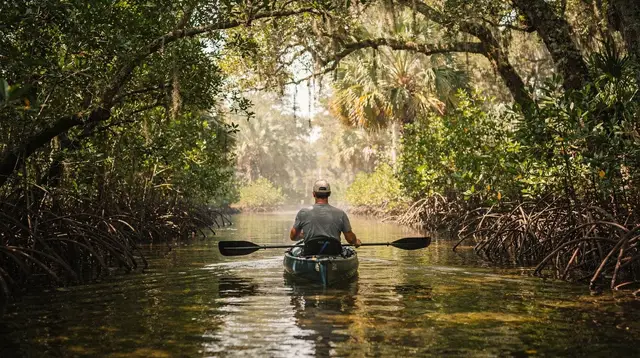
Paddleboarding the Gulf beaches around St. Petersburg
Is the Gulf coast good for beginner paddleboarding?
Yes. The Gulf side around St. Petersburg has warm, shallow water and short, gentle wind chop rather than ocean swell, which makes it far more forgiving than the Atlantic side. Mornings are usually flat; afternoon wind and summer storms are the main things to plan around, and beginners do best in a sheltered lagoon rather than open water.
Why the Gulf side suits beginners
Stand-up paddleboarding rewards calm water more than any other factor, and the Gulf coast around St. Petersburg delivers it more consistently than the Atlantic side of the state. The water here is warm nearly year-round, shallow close to shore, and protected by a chain of barrier islands that breaks up any real swell before it reaches the inner bays. What you get instead of ocean waves is short, choppy wind ripple that builds and fades with the breeze rather than a rolling swell that keeps coming whether you like it or not.
That distinction matters for a first-time paddler. Ocean swell has period and push; you can be knocked off balance by a wave you never saw building. Gulf chop is mostly wind on the surface. It is annoying when it is strong, but it is predictable, it dies down when the wind drops, and it almost never has the punch to put a beginner in the water on its own. The tradeoff is that wind, not swell, becomes the main variable to plan around, and it is the one condition on the water that changes over the course of a single afternoon.
Lagoon side versus open Gulf, and why it matters after lunch
St. Petersburg and the barrier islands create two very different paddling environments within a few minutes of each other. On the inland side sit Boca Ciega Bay, the Intracoastal Waterway, and a scatter of mangrove-lined coves and preserves such as Clam Bayou. These are lagoon water: sheltered by land on most sides, shallow, and largely immune to open-water wind because there is no long open fetch for the wind to build chop across. On the outer side sit the beaches facing the open Gulf of Mexico directly, where the same wind has open water to work with and can raise a meaningful chop by early afternoon.
The daily pattern in Florida makes this choice almost automatic. Mornings on the Gulf coast are usually the calmest hours of the day, before the sea breeze fully develops. By early to mid-afternoon, the onshore wind typically picks up, and on the open Gulf side that translates into a choppier, more tiring paddle. The lagoon side barely notices it. The practical rule: paddle the open Gulf-facing water in the morning if that is where you want to be, and shift to the lagoon side, the bay, or a mangrove-fringed cove once the wind builds in the afternoon. Trying to do it the other way around, heading out to open water in the afternoon chop, is where a relaxed outing turns into a workout.
Typical spots
| Area | Character | Best for |
|---|---|---|
| Boca Ciega Bay | Wide, sheltered bay, mostly flat | Beginners, longer paddles |
| Clam Bayou Nature Preserve | Narrow channels, mangroves, birdlife | Wildlife spotting, guided tours |
| Intracoastal Waterway | Protected channel behind the barrier islands | Easy point-to-point paddling |
| Fort De Soto sandbars | Shallow flats exposed at low tide | Sandbar walking, calm water |
| Open Gulf beachfront | Direct exposure to wind and small swell | Morning-only, experienced paddlers |
Fort De Soto and the barrier-island shallows are worth calling out specifically. At low tide, wide sand flats and bars break the surface across parts of Boca Ciega Bay and the Intracoastal system, and paddlers can step off a board onto ankle- or knee-deep sand well away from any beach. It is a good spot to rest, let kids wade, or watch wading birds working the exposed flats. A rising tide covers these bars again within a couple of hours, so treat the exposed sandbar as a temporary feature, not a fixed island, and keep an eye on how much water is coming back in before you plan a long stop there.
Mangroves and wildlife: what you might see, and the distance to keep
The lagoon side around St. Petersburg runs through fringes of red and black mangrove, and paddling along their edge, rather than motoring past in a boat, is one of the better ways to see the smaller wildlife that uses them: herons, egrets, ospreys, the occasional roseate spoonbill, and mullet jumping along the shallows. This is a different, gentler version of mangrove paddling than the tighter tunnel systems further south around Sarasota, which get their own dedicated coverage and are not part of this page.
Bottlenose dolphins move through Boca Ciega Bay and the Intracoastal Waterway with some regularity, and manatees pass through the same channels and canals, particularly as water cools in the fall and winter months. Seeing either is a genuine possibility on a Gulf-side paddle, never a guarantee, and no operator can honestly promise a sighting on a given day. If you do come across a dolphin or manatee, hold your position, do not paddle toward it or try to follow it, and let it move past or away on its own. A paddleboard sits low and is easy for an animal to approach on its own terms; closing that distance yourself is the etiquette mistake to avoid, and it can also be a legal one where manatees are involved.
The wind-from-land trap
This is the single most important safety point for anyone paddling the Gulf coast on a board rather than in a kayak or boat: an offshore wind, blowing from the land out toward open water, can feel like the easiest paddling of your life on the way out. It pushes gently at your back, you barely need to stroke, and the shoreline slips away faster than it should. The trouble comes on the way back, when that same wind is now blowing straight into your chest, and a paddleboard, with a paddler standing upright, catches far more wind resistance than a seated kayaker or canoeist. Paddling directly against even a moderate wind on a board can turn a five-minute drift into a exhausting fight that some paddlers simply cannot win, especially once arms are already tired from the outbound leg.
Before launching anywhere on the open Gulf side, check which way the wind is blowing relative to the shore. A wind blowing from the beach out toward open water is the condition to be cautious of; a wind blowing onshore, from the water toward the beach, is far more forgiving, since worst case it simply pushes you back to where you started. When in doubt, stay in the lee of a point or island, keep the outbound leg short, and turn back well before you feel tired rather than after. This single piece of judgment causes more real trouble on the Gulf coast than sharks, sunburn, or anything else on this list combined.
Rental versus guided tour
A self-guided board rental is straightforward once you can paddle a reasonably straight line, stand comfortably, and read basic wind and tide conditions. Most rental operators around St. Petersburg and St. Pete Beach hand over a board, a paddle, and a leash, point you toward a sheltered stretch of water, and let you go. It is the cheaper and more flexible option, and it suits paddlers who already know the area or are sticking to a small, enclosed lagoon.
A guided tour adds real value in three situations: your first time on a board, a trip into the mangroves or Clam Bayou where the channels are narrow and easy to get turned around in, and any outing where wildlife spotting is the point rather than a bonus. A guide reads the wind and tide before you launch, keeps the group inside sheltered water, and can point out what to look for along the mangrove edge that a first-time paddler would otherwise miss entirely.
a guided paddle board tour around St. Petersburg with wildlife spotting covers exactly this combination: sheltered water, an instructor, and a route chosen for the day’s conditions rather than a fixed loop regardless of wind. For a lower-key introduction to the same lagoon environment by kayak instead of board, a Clam Bayou Nature Preserve kayak tour threads the mangrove channels at a gentler pace, useful for anyone traveling with a member of the group who would rather sit than stand.
Timing your day around the weather
Morning is the default answer for a reason, and it holds through most of the year. Water tends to be flattest at or shortly after sunrise, before the day’s sea breeze fully develops, and the light is easier on the eyes than the glare of a Florida midday. From roughly June through September, this timing stops being a preference and becomes a plan: an intense thunderstorm builds over Central Florida and the Gulf coast almost every afternoon during these months, typically arriving sometime between early and mid-afternoon and lasting under an hour before clearing. Being off the water and back at the launch point well before that window opens is the simplest way to avoid getting caught paddling under lightning, which is a real and locally well-known risk on this coast.
Outside of summer, the storm pattern eases, but the morning-calm, afternoon-wind pattern generally persists. Fall and winter mornings on the Gulf can be genuinely still, and the water stays warm enough for comfortable paddling well into the cooler months even when the air temperature has dropped. Checking a wind forecast the morning of, not the night before, is worth the extra minute, since conditions on this coast can shift meaningfully within a few hours.
If a paddle on the water is one piece of a longer Gulf coast day, pairing it with a wildlife cruise later on rounds things out without doubling up on the same activity. a St. Petersburg sunset and dolphin cruise works well as an evening follow-up after a morning on a board, and for a nighttime look at a different side of the same shallows, a glass-bottom kayak night tour with fish feeding at St. Pete Beach shows the water from underneath rather than on top of it.
What this guide does not cover
Two related topics are deliberately left out here and covered elsewhere. The tight mangrove tunnel systems further south, with their narrow, winding channels through Sarasota’s coastline, are a distinct paddling environment with their own access points and etiquette, and get their own mangrove tunnel kayaking guide. Motorized water sports, jet skis and parasailing, share the same beaches but none of the quiet, muscle-powered pace that makes paddleboarding worth doing in the first place, and are covered in the jet ski and parasailing guide instead.
For the wider Gulf coast picture beyond paddling, the St. Petersburg destination page and the Clearwater destination page cover beaches, districts, and getting around; Clearwater Beach paddleboarding and kayaking to Caladesi and Honeymoon Island extends the same lagoon-and-barrier-island logic a little further north. For dolphin sightings specifically, rather than as an incidental part of a paddle, see dolphin watching around Clearwater and the broader dolphin cruise versus swim program comparison.
Manatee season and behavior, relevant to any paddler on these waters between roughly November and March, is covered month by month in the manatee season guide. Anyone planning a wider loop of the Gulf coast can start from the best day trips from Orlando overview or the things to do around St. Petersburg hub, and general on-water safety around alligators and freshwater bodies elsewhere in the state is covered separately in kayaking and alligator safety in Florida, which does not apply to the saltwater Gulf but is worth knowing if the same trip includes a spring or river paddle.
Gulf coast paddleboarding: common questions
Is the Gulf coast good for beginner paddleboarding?
Yes. The Gulf side around St. Petersburg has warm, shallow water and short, gentle wind chop rather than ocean swell, which makes it far more forgiving than the Atlantic side. Mornings are usually flat; afternoon wind and summer storms are the main things to plan around, and beginners do best in a sheltered lagoon rather than open water.
What time of day is best for paddleboarding around St. Petersburg?
Early morning, roughly sunrise to 10 a.m., is the most reliable window. The water is typically glassy before the sea breeze builds, and in summer this also gets you off the water well before the almost-daily late-afternoon thunderstorms.
Should I rent a board on my own or book a guided tour?
A guided tour makes sense for a first outing, wildlife spotting, or the mangrove tunnels, since a guide reads the tide and wind and keeps the group together. A self-guided rental works well once you can paddle a straight line and are staying inside a calm, marked lagoon you already know.
What is the danger with wind on a paddleboard?
An offshore wind, blowing from land out toward open water, can feel pleasant because it pushes you along with almost no effort. The problem shows up on the return: paddling back against that same wind is far harder than it looked going out, and a standing paddler catches more wind than a seated kayaker. Check the wind direction before launching and treat any wind blowing away from shore as a reason to stay close in or turn back early.
Will I see dolphins or manatees while paddleboarding?
Both are possible but neither is guaranteed. Bottlenose dolphins pass through Boca Ciega Bay and the Intracoastal Waterway fairly often, and manatees move through the same lagoons and canals, especially in cooler months. Keep well clear of any animal you spot and let it move on its own; never approach or follow.
Do the sandbars really appear at low tide?
Yes. Several spots in the Boca Ciega Bay and Intracoastal system expose sand flats and shallow bars as the tide drops, which is when wading birds and small marine life concentrate there. A falling tide can also strand a board on mud further from the channel, so check the tide chart rather than guessing.
Does this guide cover the Sarasota mangrove tunnels or jet skis?
No. The narrow mangrove tunnel paddling around Sarasota has its own guide, and motorized water sports (jet ski, parasailing) are covered separately, since the boards, hazards, and etiquette are different.
Kayak and paddleboard tours on springs and rivers on GetYourGuide
Verified deep-linked GetYourGuide tours. Book through these links and we earn a small commission at no cost to you.
GetYourGuide does not provide a product photo for this activity — the image shows the meeting point, photographed by us.