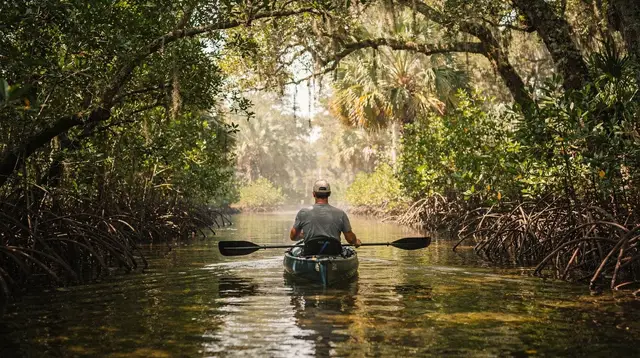
Mangrove tunnel kayaking near Sarasota and Lido Key
What is mangrove tunnel kayaking near Sarasota actually like?
Guided trips paddle narrow channels cut through red mangrove roots around Sarasota Bay and Lido Key, spotting herons, oysters, and juvenile fish at close range. Tours run about two hours and are scheduled around the tide, since the tunnels are only passable at mid to high water.
What is actually in a mangrove tunnel
Around Sarasota Bay and Lido Key, red mangroves grow straight out of the water on arched prop roots, and over decades those roots knit together into narrow, shaded corridors just wide enough for a kayak. Paddling into one feels different from open water almost immediately: the light drops, the air cools a few degrees, and the bay chop disappears into flat, tea-colored water threaded between root walls.
The roots themselves are the main show at close range. Oysters cement themselves in clusters along the submerged and tide-exposed sections, sharp enough that guides warn against grabbing a root bare-handed to steady a kayak. Fiddler crabs work the mud at the base when the tide is low enough to expose it. Small juvenile fish, snook, mullet, and other species that use mangrove roots as a nursery, dart along the shaded margins where light and shadow break up the water. Look up and it’s common to see a yellow-crowned night heron or a green heron perched motionless on a root a few feet away, waiting for exactly that kind of fish to swim past. White ibis and osprey work the taller canopy nearby, and on a quiet morning, a mangrove tunnel is one of the better places in the Sarasota area to get eye-level with a great blue heron rather than watching one from a shoreline fifty yards off.
A manatee sighting inside the tunnels themselves happens, but it is not something to plan a trip around. Manatees do use these same quiet channels, particularly when cooler weather pushes them toward warmer, sheltered water, but a guide who promises one on a summer afternoon tour is overselling it. Treat any manatee inside a mangrove tunnel as a bonus, not the point of the trip.
Why a kayak, not a paddleboard
Most operators around Sarasota and Lido Key simply do not run paddleboards into the tunnel sections, and there’s a practical reason. The passages are narrow enough in places that a kayak’s paddler barely clears the roots on either side, and the canopy overhead can drop low enough to require ducking. Standing on a paddleboard in that kind of space means constant root contact, a much higher risk of tipping into oyster-studded roots, and far less maneuverability on the sharp turns the channels require.
A seated kayak keeps the center of gravity low and gives two-handed steering control exactly where it matters most, in the tight bends where a wrong angle puts a paddle blade, or a knuckle, against oyster shell. Clear-bottom kayaks, which several Sarasota operators use, add the extra benefit of seeing fish and the occasional ray pass directly underneath without having to lean over the side. For open water paddling around the bay or out toward the barrier islands, a paddleboard is a reasonable choice; for the tunnels specifically, it generally isn’t offered, and for good reason. Anyone weighing the two approaches for the wider Gulf Coast in general can compare the tradeoffs more broadly in paddleboarding on the Gulf beaches.
The tide runs the schedule, not the visitor
This is the detail that catches people off guard: mangrove tunnels are not passable at all states of the tide. At low tide, many of the narrower channels drain down to exposed mud and bare root, too shallow to float a kayak, let alone paddle one through cleanly. At mid to high tide, the same channel fills with enough water to glide through without touching bottom.
Because of this, reputable operators set their tour departure times around the tide table for that specific day, not around a fixed daily schedule. A tour that leaves at 8 a.m. one week might leave at 1 p.m. the next, simply because high tide has shifted. This is also why calling ahead or booking through an operator who publishes tide-based times, rather than picking whichever slot looks most convenient on a booking calendar, matters more here than on most Sarasota-area water activities.
The trap is real and common: a visitor books the time that fits their day rather than the time the water allows, then spends the first ten minutes of the tour pushing a grounded kayak across exposed mud at the tunnel entrance while the guide explains, again, why the schedule works the way it does. Letting the operator set the time, rather than requesting a specific slot, avoids this outright.
| Tide stage | Tunnel conditions |
|---|---|
| Low tide | Channels often too shallow; exposed mud and roots, kayaks can ground |
| Mid tide (rising or falling) | Generally passable; conditions improve as water rises |
| High tide | Best conditions; full depth through the tunnels, easiest paddling |
What a typical trip looks like
A guided mangrove tunnel tour out of Sarasota or Lido Key runs about two hours on the water. That usually breaks down into a short briefing and paddling technique demonstration on the beach or dock, a stretch of open bay paddling to reach the tunnel system, then the tunnel sections themselves, which are paddled at a slow, single-file pace with the guide calling out turns and pointing out wildlife. Groups are typically kept small, both for logistics in the narrow channels and so the guide can actually talk everyone through what they’re seeing.
No real kayaking experience is required. Guides give basic paddling instruction before setting out, the kayaks used, generally sit-on-top or clear-bottom models, are stable and hard to capsize, and the pace through the tunnels is unhurried by design; rushing through a root-lined channel is how paddles and knuckles find oyster shell. That said, this is not a lie-back-and-drift trip. Steering through tight turns takes continuous, active paddling, and anyone with limited upper-body mobility should mention it when booking.
a clear-kayak eco tour through the Sarasota mangrove tunnels is the most common way to do this, and the clear hull adds a view of the water column that a standard kayak doesn’t offer. For a similar tunnel system a short drive north near Lido Key, a guided mangrove tunnel kayak tour based near Lido Key covers different channels with the same tide-dependent structure. Families or groups based closer to Siesta Key have a similar option in a clear kayak tour with a guide departing from the Siesta Key area. Further north toward Bradenton, a mangrove tour through Robinson Preserve reaches a different, less crowded tunnel network worth considering for a second visit.
When to go, and when it’s crowded
Winter, roughly December through February, is Florida’s high season on the Gulf Coast, and Sarasota’s mangrove tunnel tours fill up along with everything else. Snowbird visitors and mild, dry weather push demand up through this stretch, so booking a specific tour a few days ahead rather than showing up same-day is worth it from November through March. Morning departures in winter also tend to be calmer on the water, since afternoon breezes can pick up in the open-bay stretches between tunnel segments.
Summer brings its own tradeoff. The tunnels themselves, shaded and often several degrees cooler than open water in direct sun, are genuinely more comfortable to paddle in July heat than a bay crossing. But summer is also wet season, June through September, which means two things worth planning around: afternoon thunderstorms that can cut a tour short or push a departure earlier in the day, and mosquitoes, which are worse in the tunnels’ still, shaded air than almost anywhere else on a typical Sarasota itinerary. A dawn or dusk departure in wet season without repellent is the single most common regret reported after these tours.
Practical protection: apply insect repellent before getting in the kayak, not after the mosquitoes have already found bare skin, and wear light long sleeves and pants if mosquito bites are a concern rather than counting on repellent alone in the densest tunnel sections. A hat and reef-safe sunscreen matter on the open-bay stretches, where there’s no mangrove canopy for shade.
Hurricane season runs June 1 through November 30, with the highest activity from August through October, and it overlaps directly with the wet-season window described above. A named storm anywhere in the Gulf can force operators to cancel tunnel tours outright, even when Sarasota itself sees only wind and rain from the outer bands, since the same open-bay stretch that leads to the tunnels becomes unsafe well before landfall. Anyone booking a Gulf Coast trip between August and October should build in flexibility around the forecast rather than a single fixed date; the general planning approach is covered in hurricane season travel guide.
What this trip is not
Mangrove tunnel kayaking is a narrow-channel, low-speed, wildlife-focused paddle. It is not open-water paddleboarding, which is covered separately in paddleboarding on the Gulf beaches, and it is not a boat-based dolphin cruise; for a dedicated look at dolphin sightings around Sarasota Bay, see the Sarasota Bay dolphin and wildlife cruise guide and the broader comparison of boat cruise versus swim programs. It also has nothing to do with the freshwater airboat tours run through the Kissimmee marshes further inland, covered in the airboat tours guide; those are a different ecosystem entirely, and calling either one “the Everglades” is a common but inaccurate shorthand.
For manatee-focused paddling specifically, Blue Spring and the springs of the St. Johns River, not the Sarasota mangroves, are the reliable destination; see Blue Spring manatee viewing and manatee season month by month for timing. Manatees also surface in the springs around Crystal River, covered separately in the manatee swim guide for Crystal River, along with the etiquette rules laid out in manatee encounter rules and etiquette. Anyone weighing general kayak safety around alligators on Florida’s freshwater side, which does not apply in these saltwater mangrove channels, can check kayaking and alligator safety in Florida.
Getting there from Orlando and other launch points
Sarasota and Lido Key sit on the Gulf Coast, on the opposite side of the Florida peninsula from Orlando’s park corridor, so this is not a same-day add-on to a theme park visit; it’s a dedicated Gulf Coast stop, usually built into a multi-day trip or a standalone drive over from a Gulf Coast base. Anyone renting a car for the crossing can check the general ground rules in renting a car in central Florida and the toll-road basics in SunPass and E-Pass explained. Visitors who want the Sarasota mangroves as part of a broader loop rather than a single stop have a ready-made option in best day trips from Orlando, which frames Sarasota against the other Gulf Coast towns worth reaching.
Robinson Preserve, the northernmost of the four tours listed above, sits closer to Bradenton than to downtown Sarasota, so visitors staying on that side of the bay, including those based near Anna Maria Island, often find it the shorter drive of the two tunnel systems. Anyone splitting time between shelling on the barrier islands and a mangrove paddle can pair Robinson Preserve with the boat trips covered in shelling boat trips near Anna Maria.
Planning the rest of a Sarasota visit
A mangrove tunnel tour pairs naturally with a half day on the Sarasota destination guide itself, particularly a stop at Siesta Key’s quartz sand, covered in the destination guide, or a visit to the Ringling Museum. Visitors staying closer to the barrier islands north of the city may prefer the Robinson Preserve route over the Lido Key tunnels simply for drive time; both are listed above. A sunset boat ride is a natural evening pairing after a morning tunnel paddle, covered in Tampa Bay sunset cruise for those basing themselves closer to Tampa.
For a broader look at where mangrove tunnels fit against other Gulf Coast paddling, the freshwater springs further north offer a different, cooler-water counterpoint: kayaking Wekiwa Springs Run and paddling the Rainbow River are both spring-fed and freshwater rather than saltwater and tidal, and neither depends on a tide table. Visitors sticking to barrier-island paddling instead can compare the mangrove tunnels with kayaking to Caladesi and Honeymoon Island further up the coast. Anyone building a longer Gulf Coast stretch into a wider itinerary can also check three days: Orlando, Tampa, and a Gulf Coast taster for how a Sarasota stop fits alongside Orlando and Tampa.
FAQ: mangrove tunnel kayaking near Sarasota
Why kayak instead of a paddleboard in the mangrove tunnels?
The tunnels are narrow, low-ceilinged, and full of root snags and tight turns. A seated kayak gives more control and a lower center of gravity, so most operators simply don’t offer paddleboards for the tunnel routes, only for open-water sections.
How long does a mangrove tunnel kayak tour take?
Most guided tours run about two hours on the water, including a briefing and a slower stretch of open bay before or after the tunnels. Self-guided rentals can run longer, but the tunnels themselves are only paddled for a portion of that time.
Do I need kayaking experience for a mangrove tunnel tour?
No prior experience is required for most guided tours, which use stable sit-on-top or clear-bottom kayaks and keep the pace slow. Basic comfort with paddling and following a guide’s instructions in tight quarters is enough.
Why do mangrove tunnel tours run on a tide schedule instead of a fixed time?
The tunnels drain to bare mud and exposed roots at low tide, so they are only passable from about mid tide to high tide. Operators set departure times around the tide table for that day, which is why the same tour company may run at 8 a.m. one week and 2 p.m. the next.
Will I see a manatee in the mangrove tunnels?
Sometimes, but never guaranteed. Manatees do move through the same quiet channels, especially in cooler months, but sightings are occasional, not a scheduled part of the tour.
Are mosquitoes a problem on mangrove tunnel kayak tours?
They can be, especially in the wet season from June through September and around dawn or dusk departures. Insect repellent and long sleeves make a real difference; the tunnels themselves, shaded and still, tend to hold more mosquitoes than open water.
Is Sarasota mangrove tunnel kayaking the same as an Everglades airboat tour?
No. Mangrove tunnel kayaking is a quiet, self-paddled trip through coastal root channels around Sarasota Bay and Lido Key. It has nothing to do with the freshwater marsh airboat tours run out of Kissimmee, which cover different terrain entirely.
Kayak and paddleboard tours on springs and rivers on GetYourGuide
Verified deep-linked GetYourGuide tours. Book through these links and we earn a small commission at no cost to you.
GetYourGuide does not provide a product photo for this activity — the image shows the meeting point, photographed by us.