The oldest city, and why its layout still shapes a visit
St. Augustine was founded in 1565 by Pedro Menendez de Aviles, which makes it the oldest continuously occupied European-founded city in the United States. That single fact explains almost everything about how the town is arranged today: a compact colonial-era core built for walking, not for cars, wrapped by later additions that only make sense once you know the timeline. Plan the day around four distinct zones rather than a list of attractions, because they sit in a line and you will move through them in this order whether you mean to or not.
From Orlando, the drive is about 170 kilometers (105 miles), roughly 2 hours via the I-4 east and then the I-95 north. It is a straightforward highway run with no tolls that require a transponder for most routes, though always check current signage. Leave by mid-morning if you want a relaxed pace, or earlier if you are trying to fit the fort, a walking tour, and a boat cruise into a single day.
The four zones, in the order you will actually experience them
- The historic core around St. George Street, pedestrian-only for several blocks, lined with colonial-era buildings, small museums, and shops. This is where most people spend the bulk of their time.
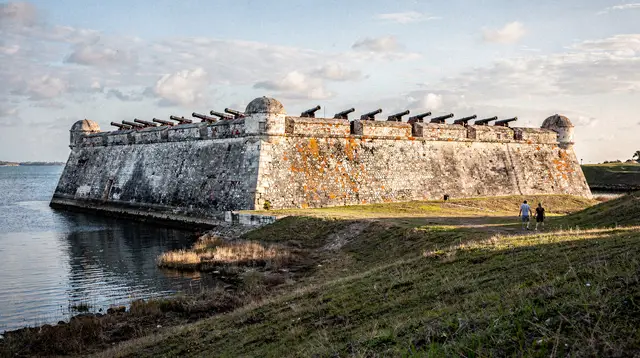
- The Castillo de San Marcos, the stone fort on the bay, visible from most of downtown and impossible to miss.
- The Flagler hotel district, a cluster of grand late-19th-century buildings a short walk from the old town, built during Henry Flagler’s push to turn the city into a winter resort.
- Anastasia Island, across the Bridge of Lions, where the beaches are.
St. George Street and the historic core
St. George Street is the spine of the old town: a narrow, pedestrian corridor of coquina and wood-frame buildings, small museums, bakeries, and souvenir shops that runs from the old city gate down toward the plaza. It is touristy in stretches, and it is also genuinely old in a way few American streets are. Expect to walk it slowly, in and out of side alleys, more than once during the day.
The Colonial Spanish Quarter living-history sites sit just off the street, with interpreters in period dress demonstrating trades from the Spanish colonial period. A guided walking tour is the easiest way to get the context that a self-directed stroll misses entirely, and several operators run them from the plaza multiple times a day.
For a first orientation to the city’s full timeline, a museum stop works better than jumping straight into the fort. A guided history museum experience walks through the Spanish, British, and American periods in about an hour, which makes the rest of the day easier to place in context. If wax figures and dioramas are more your family’s speed, Potter’s Wax Museum is one of the oldest attractions in the city and sits right in the historic core.
The Castillo de San Marcos
The Castillo de San Marcos, built between 1672 and 1695 out of coquina, a limestone made of compacted shell, is the single most important structure in the city and it dominates the waterfront. Coquina’s odd property is that it absorbs cannonballs rather than shattering, which is part of why the fort survived centuries of sieges intact. It is managed by the National Park Service, and a ticket is valid for seven days, so if you are staying overnight there is no need to rush the fort visit on day one.
Full detail on visiting the fort, ranger talks, and cannon-firing demonstrations belongs to a dedicated guide; see Castillo de San Marcos and historic sites for the walkthrough. From the destination-planning level, the practical point is simpler: budget an hour minimum, more if you want a ranger-led talk, and see it either right after arriving or as a late-afternoon stop when the light off the bay is best for photos.
The Flagler district: hotels built for a different century
A short walk from the historic core sits the Flagler district, a cluster of Gilded Age buildings from Henry Flagler’s 1880s effort to make St. Augustine a winter destination for wealthy northerners. The centerpiece is the former Hotel Ponce de Leon, opened in 1888 and now home to Flagler College; its lobby and courtyard are open to visitors on guided campus tours. Nearby, the Lightner Museum, housed in the old Hotel Alcazar, holds a dense collection of Gilded Age decorative art, and an entry ticket is worth the hour it takes to see the main galleries and the indoor courtyard.
This district is easy to skip if you are pressed for time, but it is the part of the city most visitors do not expect, since the wooden-and-coquina old town gives no hint of Spanish Renaissance-style hotel architecture a few blocks over. It rewards even a 30-minute walk-through between other stops.
Anastasia Island and the beach side
Across the Bridge of Lions, Anastasia Island is a different city altogether: beach houses, a lighthouse, and open Atlantic coastline. St. Augustine Beach is the main public strand, wide and generally uncrowded compared to Cocoa Beach or Daytona Beach further south. If your day trip has any flexibility, this is the natural place to unwind after a morning of walking the old town on foot.
The island also anchors most of the water-based activity out of St. Augustine. A sunset cruise on the bay is the classic evening option, timed to put the fort and the old town skyline behind you as the light goes gold. For wildlife rather than skyline, a paddle or kayak tour works the tidal creeks around the island where dolphins and, in cooler months, manatees are commonly seen.
Ghost tours: the evening activity everyone asks about
St. Augustine markets itself heavily on its ghost-tour circuit, walking the same colonial streets after dark with a different set of stories attached. It is a genuine local institution, not a gimmick bolted on for tourists, and it works well as the evening half of an overnight stay. Full detail on the different formats and which suit which age group is covered in St. Augustine ghost walks; the short version here is that this is an after-dark activity, so it only fits a day-trip itinerary if you are prepared to drive back to Orlando late.
Food in the old town
St. Augustine’s food scene leans into Spanish colonial and Minorcan influences unique to this part of Florida, particularly datil pepper, a local hot pepper brought by 18th-century Minorcan settlers and used in sauces across the city. A guided tasting walk through the historic core is the easiest way to sample several kitchens without guessing; see St. Augustine food tasting tour for what a typical route covers.
Nights of Lights: late November through early January
From late November through early January, the historic district is strung with roughly three million small white lights across the old town’s trees and buildings, an event known as the Nights of Lights. It is one of the most photographed displays in Florida and draws heavy evening crowds during this window, particularly weekends and the week between Christmas and New Year. Parking and walking pace both slow down considerably; if you are visiting specifically for the lights, arrive before dusk to find parking and walk the core streets before they fill in. A boat cruise during the light display is a good way to see the skyline from the water rather than fighting foot traffic on St. George Street.
Seasons: when to go and what to expect
| Season | Weather | Crowds | Notes |
|---|---|---|---|
| Spring (Mar-May) | 21-28 C, dry | Moderate, higher over spring break | One of the two best windows |
| Summer (Jun-Sep) | 30-33 C, humid, afternoon storms | High | Hot for walking; plan indoor stops midday |
| Fall (Oct-Nov) | 24-28 C, drier | Lower after early Oct | The other best window |
| Winter (Dec-Feb) | 15-21 C by day | High late Nov to early Jan (lights), lower otherwise | Nights of Lights draws evening crowds |
Hurricane season runs June 1 through November 30, with the highest risk August through October; St. Augustine sits directly on the coast, so storm tracking matters more here than in inland Orlando.
Getting there and the parking mistake to avoid
The single most common mistake in St. Augustine is driving straight into the historic core expecting to park near St. George Street. On-street parking downtown is scarce, metered, and often full by mid-morning, and circling side streets looking for a spot burns far more time than the alternative. The better approach is one of the park-and-walk lots on the edge of downtown, or the larger visitor center parking garage a few blocks from the plaza; from any of these, it is a short walk into the pedestrian core, and it is consistently faster than hunting for street parking.
If you are staying overnight, ask your hotel about parking before booking, since several historic-district inns have very limited on-site spaces.
Where St. Augustine fits in a Central Florida trip
St. Augustine pairs naturally with the rest of the Atlantic coast: it is a reasonable add-on to a Space Coast trip if you are willing to make a longer day of it, and it is a common stop on multi-day loops that also include Daytona Beach partway along the route north. For a structured single day, see St. Augustine old town tour for first-timers; for a broader look at how it fits against other options, see best day trips from Orlando. It does not pair with a same-day theme park visit; treat it as its own day, not a stop tacked onto a Walt Disney World or Universal Orlando Resort day.
Frequently asked questions about visiting St. Augustine
How far is St. Augustine from Orlando?
About 170 kilometers (105 miles), roughly a 2-hour drive via the I-4 east and then the I-95 north. There is no direct train or bus route that makes sense for a day trip; driving is the practical option.
Can I visit St. Augustine as a day trip from Orlando?
Yes. A full day covers the historic core, the fort, and a meal, and gets you back to Orlando by evening. An overnight is more comfortable if you also want the beach, a boat cruise, or an evening ghost tour, since the round-trip drive alone is around 4 hours.
Where should I park in St. Augustine?
Avoid driving into the historic core itself, since street parking is scarce and metered. Use one of the park-and-walk lots or the visitor center parking garage on the edge of downtown and walk in; it is faster than circling for street parking.
When is the best time to visit St. Augustine?
Spring (March-May) and fall (October-November) offer the mildest, driest weather. Late November through early January adds the Nights of Lights display, but expect heavier evening crowds during that window.
Is the Castillo de San Marcos worth visiting?
Yes, it is the defining structure of the city, built from coquina between 1672 and 1695 and still standing on the bay. A ticket is valid for seven days, so it is easy to fit around the rest of a historic-core visit.
What is St. Augustine famous for?
It is the oldest continuously occupied European-founded city in the United States, founded in 1565 by Pedro Menendez de Aviles. Its historic core, the Castillo de San Marcos fort, and the Gilded Age Flagler hotel district are the main draws.
Do I need a full day, or can I see St. Augustine in a few hours?
A few hours covers only a rushed walk down St. George Street and a quick look at the fort exterior. A full day is the realistic minimum to see the historic core, go inside the fort, and have a meal; an overnight is better if you want the beach or an evening activity as well.
Is St. Augustine walkable, or do I need a car within the town?
The historic core itself is compact and pedestrian-friendly, built for walking long before cars existed. You need a car to get there and to reach Anastasia Island and the beaches, but once parked at the edge of downtown, everything in the old town is within easy walking distance.