Disney Lightning Lane explained: how it actually works
What is Disney's Lightning Lane and how do you buy it?
Lightning Lane is Walt Disney World's paid skip-the-standby-line system, bought inside the My Disney Experience app after you already hold a valid park ticket and reservation. It comes in two forms: a per-person, per-day multi-pass covering a set of attractions, and single-purchase passes for the handful of headline rides that sit outside that pass.
What Lightning Lane actually is
Lightning Lane is Walt Disney World’s paid system for shortening the standby wait at a set list of attractions inside Magic Kingdom, EPCOT, Disney’s Hollywood Studios and Disney’s Animal Kingdom. It is not a ticket on its own — it is an add-on you buy after you already hold a valid park ticket, inside the My Disney Experience app, for a specific park on a specific date. Buying Lightning Lane without a valid ticket and park reservation for that day is not possible, which is a detail worth checking before assuming a purchase will go through the morning of your visit.
The system works in two separate layers, and confusing them is the single most common planning mistake:
- Lightning Lane Multi Pass — a per-person, per-day purchase that covers a set list of attractions in one park. You select an initial attraction and time window when you buy it, then keep booking additional attractions from the covered list through the day, one at a time, as earlier windows are used or expire.
- Individual Lightning Lane — a separate, per-attraction purchase for the small number of headline rides that sit outside the multi-pass entirely. These are bought and used independently of the multi-pass, and having the multi-pass does not include them.
Neither layer replaces the Walt Disney World ticket itself, and neither replaces a Park Hopper add-on if you plan to move between parks in one day — that is a separate purchase covered on its own page, not here.
Booking Lightning Lane inside My Disney Experience
The purchase and the booking both happen in the My Disney Experience app, not at a kiosk or a cast member podium, though in-park help is available if the app gives trouble. The practical sequence for the multi-pass:
- Confirm your park ticket is linked to My Disney Experience and that you hold a valid reservation for the park you’re entering that day.
- Open the Lightning Lane section in the app on the morning of your visit (or, for guests staying at a Walt Disney World resort hotel, earlier — resort guests get a head start on the booking window that day-guests don’t).
- Buy the multi-pass for that park and immediately book your first attraction and return window.
- Once that window opens or is used, book the next attraction from the covered list, and repeat through the day.
The booking window for individual Lightning Lane on the headline rides typically opens earlier in the morning, often before the park’s official opening time, and separately from the multi-pass flow. This is the detail that catches first-timers: buying the multi-pass the night before does not lock in a return time for the headline attractions, because those aren’t part of the multi-pass and open for booking on their own schedule the same morning.
What it costs, and why there’s no single price
Lightning Lane pricing is dynamic: it moves with the park, the date, and demand, the same way the dated park ticket itself does. As a rough 2026 order of magnitude, expect the multi-pass to run from around the mid-double digits per person on a quiet weekday to well over a hundred dollars per person on a peak date at the busiest park. Individual Lightning Lane for a single headline attraction can range from roughly 10 to 30 USD per person per ride on a normal day, climbing higher around holidays.
Those numbers are a planning range, not a quote — the only reliable price is the one shown in the app for your specific park and date, and it can differ meaningfully between, say, a Tuesday in late January and the week between Christmas and New Year’s. Two things to remember every time you budget for it:
- The price is per person, per day, added on top of the park ticket, never bundled into it.
- It does not include or replace the park reservation — you still need a valid entry for that park on that date before Lightning Lane can be purchased.
| Layer | Covers | Typical 2026 range (per person) | Booked when |
|---|---|---|---|
| Multi Pass | A set list of attractions per park | Roughly 30–150+ USD, park and date dependent | Morning of visit (or earlier for resort guests), then rebooked through the day |
| Individual Lightning Lane | A small number of headline rides only | Roughly 10–30+ USD per attraction | Separate morning booking window, same day |
When it changes something and when it doesn’t
Lightning Lane earns its cost when standby waits are already long — which mostly means high-attendance periods and the middle of the day. Its effect is smallest at two predictable moments:
- Rope drop, the first 30 to 60 minutes after opening, when standby lines for even popular attractions are often close to a walk-on anyway. Paying for Lightning Lane to use in the first hour is frequently money spent on a wait you’d barely have had.
- The last hour before close, when crowds thin and standby lines drop again, especially on nights with an evening event or a parade pulling guests elsewhere.
The system matters most from roughly late morning through late afternoon, when standby waits for the marquee attractions regularly stretch past 60 or 90 minutes. If your day is built around that middle stretch — which for most families it is, once the morning’s rope-drop plan is used up — Lightning Lane converts several hours of unpredictable standing into a series of short, scheduled returns.
It is worth being honest about the ceiling here too: Lightning Lane shortens a wait, it does not remove it. A typical Lightning Lane return still means a queue of perhaps 10 to 20 minutes once you arrive at your window, not an instant walk-on, and on the busiest dates of the year even Lightning Lane return times can run longer than that.
Who it’s worth the money for
- A single, short park day. If you have one day at Magic Kingdom and want to see the headline attractions without gambling three hours of that one day on standby lines, the cost is easy to justify against the alternative of missing something entirely.
- High-attendance dates. Around US school holidays, spring break, Thanksgiving week, and the December holiday stretch, standby waits for the busiest rides can run well over two hours. Lightning Lane’s value scales with how bad the standby line would otherwise be.
- Families with young children. A toddler or preschooler who can’t manage a 90-minute standby wait is the clearest case for paying — the alternative isn’t a cheaper day, it’s a day that doesn’t work.
- Anyone stacking multiple parks in a short trip. On a three-day Walt Disney World visit, losing a morning to one long line has a bigger relative cost than it would on a two-week trip with slack built in.
Who can skip it
- Guests on a slow-season weekday. In the second half of January, early September, or other genuinely quiet stretches, standby lines for most attractions can already run under 30 minutes, which narrows or erases the time Lightning Lane buys back.
- Multi-day, unhurried trips. With four or five days across the parks, most families can absorb a couple of long standby waits without it derailing the trip, and can shift ride priorities to lower-wait windows instead of paying to compress everything into fewer days.
- Travelers on a tight trip budget. Lightning Lane for a family of four can add well over a hundred dollars to a single park day; for some parties that money is better spent on an extra day at the parks, a springs day trip, or simply kept unspent.
There’s no universal answer — it depends on days available, party composition, and the calendar date, not on a fixed rule that Lightning Lane is always or never worth it.
The mistake almost everyone makes once
The single most common planning error is buying the multi-pass the night before and assuming that purchase reserves the most in-demand return times. It doesn’t. The multi-pass purchase itself can often be made ahead, but the actual booking of return windows for the most popular attractions opens the same morning, and for the very busiest rides those slots can be gone within minutes of the window opening — sometimes before a family has finished breakfast.
The practical fix is simple: know the exact time the booking window opens for your specific ticket type (it differs for resort guests versus day guests), have the app open and logged in with tickets already linked before that moment, and book your first, highest-priority attraction the instant the window opens — not after finishing packing, parking, or the walk from the tram. Treat it the same way you’d treat booking a table at a restaurant with a hard 60-day window: the plan has to exist before the moment it opens, not after.
A second, smaller trap: individual Lightning Lane for headline rides is bought and tracked separately from the multi-pass. Assuming the multi-pass “covers everything” and skipping the individual booking window for a must-ride attraction is how families end up standing in a two-hour standby line for the one ride they most wanted to shortcut.
Getting to the parks and filling the rest of the trip
Lightning Lane only matters once you’re inside the gates, so the rest of the day still needs the basics sorted — transfers from MCO, a place to stay, and a realistic sense of how many park days actually suit your group.
book Walt Disney World park entry tickets ahead of your trip, since Lightning Lane can only be added on top of a ticket you already hold, never in place of one.
For a Disney resort stay without renting a car, a private transfer takes the guesswork out of the first morning: arrange a direct transfer between Orlando International Airport and your Disney resort.
If your trip includes a rest day away from the parks — and after a Lightning-Lane-paced park day, most families need one — a change of pace helps: book an evening dinner show as a lower-key alternative to another full park day, or for a splurge that shows the parks from an entirely different angle, take an after-hours helicopter flight over the theme park corridor.
Before deciding how much of your budget to put toward Lightning Lane, it helps to settle how many park days you actually need and when park tickets themselves should be booked — both change the calculation more than the Lightning Lane price itself does. If you’re weighing Walt Disney World against Universal Orlando Resort and how their paid skip-the-line systems compare, that’s covered on its own Lightning Lane versus Express Pass comparison rather than here.
For the wider question of Disney versus Universal as a whole, see the dedicated comparison guide; for choosing between Magic Kingdom and EPCOT on a single-park day, that comparison is also covered separately. And if this is a first Walt Disney World trip altogether, the first-trip planning guide is the better starting point before diving into Lightning Lane specifics.
Disney Lightning Lane: frequently asked questions
Does Lightning Lane replace the theme park ticket?
No. It is an add-on. You still need a valid Walt Disney World ticket and, in most cases, a park reservation for that date before Lightning Lane can be added to your day.
Can I buy Lightning Lane the night before?
You can buy the multi-pass the night before for the next day, but the best return times for the most popular attractions are usually gone within minutes of the selling window opening that morning, so buying early rarely means buying at 8pm the night before.
Does Lightning Lane guarantee no wait at all?
No. It shortens the wait to a short, bounded window, typically under 15 to 20 minutes, but it is not an instant walk-on and the return time itself can slip during high-demand periods.
Is Lightning Lane the same at every Walt Disney World park?
The mechanism is the same, but the price and the list of attractions covered differ by park and change with demand and date, so what you pay at Magic Kingdom is not a guide to what you’ll pay at EPCOT the same week.
Do children need their own Lightning Lane purchase?
Yes. Lightning Lane is priced and booked per person, so every member of the party who wants the shorter line, including children old enough to ride, needs it added to their own park ticket.
What happens if I miss my Lightning Lane return window?
Most return windows have a short grace period, often around 15 minutes past the printed end time, but arriving well outside that window can mean the pass for that attraction is no longer valid and the slot is not automatically rebooked.
Should a first-time visitor with one park day buy Lightning Lane?
On a single, high-demand day it is often worth the cost, since it converts unpredictable standby waits into planned time, but on a slow-season weekday with short standby lines the same money is better spent elsewhere.
Theme park tickets and passes on GetYourGuide
Verified deep-linked GetYourGuide tours. Book through these links and we earn a small commission at no cost to you.
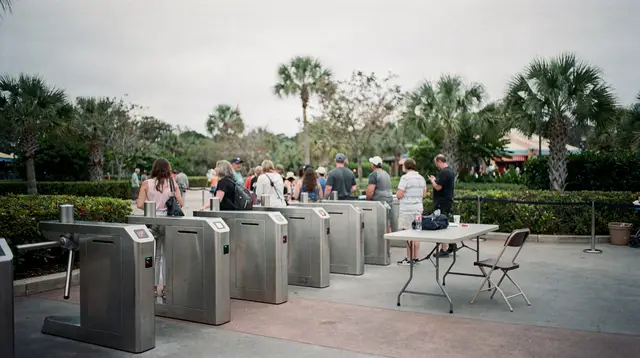
GetYourGuide does not provide a product photo for this activity — the image shows the meeting point, photographed by us.