One day at Magic Kingdom: an hour-by-hour plan
Why one park, not one park and a half
Magic Kingdom opened on October 1, 1971 and is still the busiest of Walt Disney World’s four theme parks, which makes a single day here a real planning exercise rather than a stroll. The park sits inside the roughly 110-square-kilometer resort that spans Lake Buena Vista and Bay Lake, across Orlando and the neighboring counties — the resort is not administratively part of the city, even though everyone calls it “going to Orlando.”
The plan below assumes you’re here for Magic Kingdom only, arriving with a dated ticket already in hand. If you’re still deciding between parks or building a longer trip, that decision and the day-by-day version belong on how many days you need in Orlando and in the Disney versus Universal comparison — this page stays focused on the single day.
Day 1: Magic Kingdom, start to finish
7:00 to 8:15 — getting there before the gates open
Arrive at the turnstiles about 45 minutes before the official opening time, not 45 minutes before you’d like to start riding. Disney regularly opens the park’s entrance area and sometimes a few attractions ahead of the posted hour, and that early window is worth more than almost anything else you’ll do today.
Without a car, three realistic routes get you there:
| Route | From | Approximate time |
|---|---|---|
| Disney resort hotel shuttle | Any Disney-owned hotel | 20-30 minutes, included |
| Rideshare or hotel shuttle | International Drive hotels | 25-40 minutes |
| Monorail or ferry | Transportation and Ticket Center | 10-15 minutes from TTC |
If you’re driving in yourself, the standard theme park lot runs around 35 USD per car per day, and the walk plus tram from a standard spot to the entrance adds a genuine 20 to 30 minutes each way — factor that into your wake-up call. Anyone staying off-property and renting a car should also budget for tolls on the way in; most of the roads feeding the parks charge by license-plate camera rather than a cash booth. For the airport side of the day, see MCO arrival and transfers or, if you flew into the secondary airport, Sanford airport transfers.
If you’re not driving and not on a Disney shuttle, arrive by monorail or ferry from the Transportation and Ticket Center rather than trying to walk in — there’s no direct road access to the entrance for guests on foot.
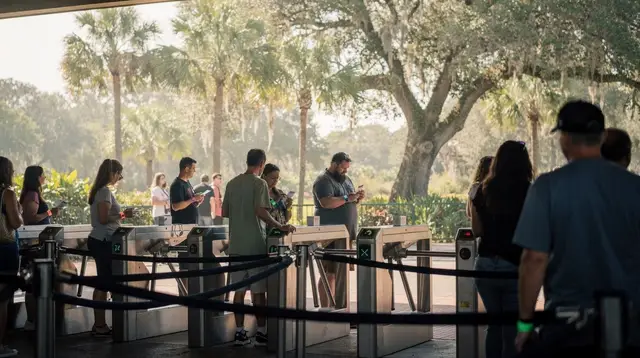
8:15 to 8:45 — the tourniquets and Main Street U.S.A.
Bag check and ticket scan take longer than they look on a crowded morning, so the 45-minute buffer isn’t padding. Once through, you’ll be held on Main Street U.S.A. until the rope drops. Resist the urge to shop here now — do it on the way out, when the crush has thinned.
8:45 to 12:00 — the land order that avoids midday lines
When the rope drops, the crowd splits roughly two ways: toward Fantasyland and toward Frontierland/Adventureland. Whichever half is less crowded that morning, go the other way first — Magic Kingdom’s biggest afternoon bottlenecks are consistently Fantasyland’s family rides, so hitting them at opening rather than at 11 a.m. saves the most time.
A workable order for a first visit:
- Fantasyland headline rides first, while the morning crowd is still filtering in through Main Street.
- Adventureland and Frontierland next, since these lines build more slowly through the morning.
- Tomorrowland by mid-morning, before lunchtime crowds arrive from off-property.
- Liberty Square as a lower-intensity stop whenever your legs need a break from headline queues.
Plan on walking 15 to 25 kilometers over the day — that’s the single most underrated fact about a theme park day, more relevant to how you’ll feel by 6 p.m. than any queue strategy. Broken-in shoes matter more than any paid line-skip product.
12:00 to 2:30 — lunch and the afternoon storm lull
Table-service restaurants inside Magic Kingdom take reservations up to 60 days out, and if you didn’t book one, quick service is the fallback — expect a line at peak lunch hour regardless. Refillable water bottles fill for free at fountains throughout the park; in Florida’s summer heat that’s not a minor convenience.
From June through September, expect a sharp afternoon thunderstorm most days, usually for about an hour sometime after lunch. It’s predictable enough to plan around: treat early-to-mid afternoon as your indoor-attraction and show window rather than fighting the outdoor queues in a downpour. This is also when the midday crowd peaks regardless of weather, so a deliberate slow patch — a sit-down meal, an indoor ride, air-conditioned shopping — does double duty. For what a Florida summer day actually feels like beyond the rain, see summer heat and storms.
2:30 to 5:30 — the second push
Energy and crowds both dip in the mid-afternoon lull, which makes this a good window to pick up whatever you skipped that morning, particularly rides in Frontierland and Liberty Square that draw shorter lines once the initial rope-drop rush has scattered. If a storm has passed through, outdoor lines often shrink further right after — locals know to move in behind the rain, not avoid the park because of it.
5:30 to 8:00 — dinner and the evening stretch
Crowds start to thin as day-trippers head out for dinner, which briefly softens some lines before the evening spectacular pulls everyone back toward Main Street. This is a reasonable window for a second pass at anything with a long morning queue, or for the attractions that only run well after dark.
8:00 to close — fireworks and the exit
Whatever the current nighttime spectacular is called this season, it draws the single largest concentration of guests onto Main Street U.S.A. and the surrounding hub, so claim a viewing spot 30 to 45 minutes ahead if you care about sightlines. After it ends, the exit crush is real: monorail and ferry queues back up fast, and a rideshare pickup can take longer to reach than the ride itself. Budget an extra 30 to 45 minutes to actually leave the property.
Do you need Lightning Lane?
Disney’s paid line-skip product changes in detail from season to season, so treat the mechanics — not the exact price — as the constant: it’s a per-person, per-day, per-attraction add-on layered on top of your park ticket, and it does not cover every attraction. As of 2026, a one-day adult ticket runs on the order of 190 USD depending on the date, and the Lightning Lane add-on is a separate charge on top of that.
The honest answer is that it’s a morning-of decision, not one to lock in weeks ahead:
- If you arrived at rope drop and worked the land order above, you may not need it at all on a slower day.
- If the park feels unusually full by 9 a.m. — school holidays, a major U.S. weekend, the week around Christmas — buying it before 10 a.m. is worth more than buying it at 1 p.m., once the best return times are gone.
- Full mechanics, current naming, and how it compares to Universal’s version are covered separately in Lightning Lane explained and Lightning Lane versus Express Pass — don’t treat either name here as fixed, since both operators tweak the program more than once a year.
What you’re sacrificing today
Being honest about trade-offs is the point of a one-park day. On this plan, you are not doing:
- EPCOT, Disney’s Hollywood Studios, or Disney’s Animal Kingdom — comparing them is covered in Magic Kingdom versus EPCOT.
- Either water park, Typhoon Lagoon or Blizzard Beach.
- Two or three of Magic Kingdom’s own major attractions — with the busiest crowd levels, something has to give even inside this one park.
The single biggest mistake worth naming directly: don’t try to combine Magic Kingdom in the morning with a second park in the afternoon using a Park Hopper add-on. The internal transfer — bus, monorail, or drive between resort areas — realistically eats close to two hours round trip once you count walking and waiting, and the result is usually a rushed, unsatisfying half-day at both parks instead of a complete day at one. If you want two parks, give each its own full day; see Disney versus Universal for how to sequence a short multi-park trip, or the two-day Universal Orlando Resort itinerary for what that second day looks like on its own.
Beyond the park gates
For arrival logistics from either Orlando airport, MCO arrival and transfers covers the standard routes, and airport transfer options compared lines up shuttle, rideshare, and rental costs side by side. If you’re staying off Disney property to save on the resort fee that catches many International Drive hotels off guard, the I-4 traffic guide and public transport options are worth reading before you fix your wake-up time. For a lighter evening once the parks are done for the trip, International Drive’s attractions sit a short ride away, and a family portrait session is a common add-on covered separately at Orlando vacation photoshoots.
book a shuttle transfer straight to the theme park gates if you’re staying off-property and want to skip driving and parking altogether. For a change of pace after the park closes, see the illuminated resort from a helicopter flight after dark, or fill a rain-delayed afternoon with a visit to the Madame Tussauds wax museum on International Drive. Traveling with restless teens who’d rather skip a second park day entirely? an arcade and mystery fun house outing is an easy evening alternative.
Magic Kingdom one-day plan: frequently asked questions
Is one day enough to see Magic Kingdom?
For most first-time visitors, yes, if you arrive 45 minutes before opening and follow a land order that front-loads Fantasyland. You’ll cover the large majority of headline attractions across all four lands, but plan to skip two or three major rides rather than rushing everything.
What time should I arrive at Magic Kingdom?
Aim to be at the turnstiles about 45 minutes before the posted opening time. Disney frequently opens the entrance area, and sometimes select attractions, ahead of the official hour, and that early window carries more value than any in-park strategy later in the day.
Should I buy Lightning Lane for a single day at Magic Kingdom?
Decide the morning of, based on how full the park feels by around 9 a.m. On a quieter day, arriving at rope drop and working an efficient land order may make it unnecessary; on a visibly busy day, buying it early beats buying it after the best return times are gone.
Can I do Magic Kingdom and another park in the same day with a Park Hopper?
It’s technically possible but rarely works well. The internal transfer between resort areas takes close to two hours round trip once walking and waiting are counted, which usually means a rushed, unsatisfying visit at both parks instead of a full day at one.
How do I get to Magic Kingdom without a car?
Disney resort hotels run their own shuttles directly to the park. From off-property, a rideshare or hotel shuttle to the Transportation and Ticket Center connects to Magic Kingdom by monorail or ferry, both faster than driving and parking yourself.
What happens at Magic Kingdom if it rains in the afternoon?
Summer afternoons commonly bring a sharp thunderstorm for about an hour, and it’s predictable enough to plan around. Treat that window as your time for indoor attractions, shows, or a sit-down meal, since outdoor queues clear quickly once the storm passes.
How much walking is involved in one day at Magic Kingdom?
Expect 15 to 25 kilometers of walking over a full park day. It’s a bigger factor in how the day feels than the queue strategy, so broken-in, comfortable shoes matter more than any paid line-skip add-on.
Where should I stand for the evening fireworks?
Claim a spot on Main Street U.S.A. or the central hub 30 to 45 minutes before the show. It draws the largest single crowd of the day, and the exit afterward is genuinely slow — budget an extra 30 to 45 minutes just to leave the property.
tours.1 days
Verified deep-linked GetYourGuide tours. Book through these links and we earn a small commission at no cost to you.
GetYourGuide does not provide a product photo for this activity — the image shows the meeting point, photographed by us.