The springs as a counterpoint to the parks
What three days of queues do to a person
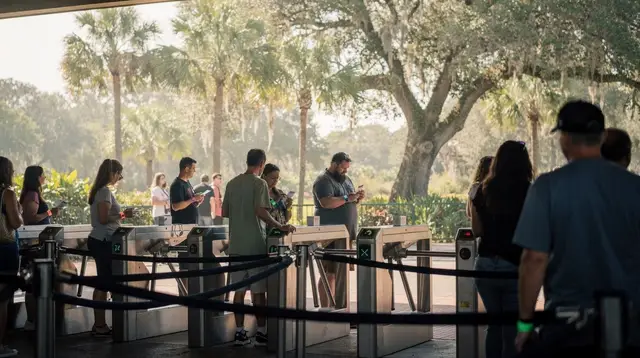
By the third morning of Walt Disney World, I had stopped noticing the heat. That is not a compliment to my stamina; it is a warning sign. I had also stopped noticing the crowds, the loudspeaker announcements, the particular smell of sunscreen and churros that follows you from land to land. None of it registered anymore, because I had gone numb to it, the way you go numb to a noise that never stops. What I noticed instead, driving north on a whim toward Ocala with no plan beyond “somewhere with water,” was how loud my own head had gotten.
I did not go looking for a spiritual experience. I went looking for shade and a place to sit still. I found both at Wekiwa Springs State Park, thirty minutes from where I had been standing in a Lightning Lane line the day before, and the difference was not subtle. It was not better than the parks — that comparison does not really hold up, because they are not doing the same job. It was a different register entirely, and I had forgotten that register existed.
The water does something a park cannot
The springs of central Florida come out of the aquifer at roughly 22 degrees Celsius, and they hold that temperature through August and through January alike, which sounds like a piece of trivia until you are actually in the water. In summer, it is a relief from air that sits somewhere near body temperature. In winter, when the surface air has dropped into the low teens at dawn, the spring is the warmest thing outdoors, and steam rises off it like a kettle. Either way, your body reads the same signal: something here is stable. Nothing in a theme park gives you that. Everything in a theme park is engineered to escalate — the next drop, the next reveal, the next thing you are supposed to feel. A spring just sits there, has always sat there, and will keep sitting there after you leave.
The light is different too, and I did not expect that to matter as much as it did. Parks are lit for spectacle — bright, saturated, designed to be photographed at its most flattering angle. A spring run under oak canopy filters the sun into something moving and green, and the water itself is often so clear that you can watch a gar drift past your ankles from a boardwalk twenty feet up. At Silver Springs, that clarity is the whole point: glass-bottom boats have worked that water since long before anyone thought to put a mouse on a hill, and the view down through the water column has not needed updating since.
What actually slows down
It is tempting to describe this as “unplugging,” but that framing gives the parks too much credit and the springs too little. What changes is pace, specifically. A park day runs on a schedule you did not write — ride times, dining reservations, park-hopper logistics, the low hum of optimizing your route so you are not wasting a minute of a ticket that cost real money. A morning at Blue Spring or Alexander Springs runs on no schedule at all. You float, you get out, you sit on a bench, you get back in. Nobody is measuring your throughput. That absence of measurement is, I think, the entire mechanism. It is not that the water is magic. It is that nothing is asking anything of you.
There is also the matter of cost, which I bring up not to moralize but because it genuinely changes how you hold the day. A single day at a major theme park now runs well into triple digits per person before you have bought a meal, and that price tag sits in the back of your mind the whole time, quietly pressuring you to extract value from every hour. A state park entrance runs a few dollars per carload. You stop calculating. You stop feeling like you owe the day a return on investment, and that alone is worth the drive.
The part nobody puts in the brochure
Here is where I have to be honest about the other side of this, because it would be dishonest to sell the springs as some undiscovered antidote that is always waiting for you. They are small. Blue Spring’s swimming area is a fraction of the size of a single Magic Kingdom land, and Wekiwa’s is smaller still. On a warm Saturday, or really any day between Memorial Day and Labor Day, these places fill up, and when they fill up, they close the gate. Not “long line,” not “wait an hour” — closed, full, redirected elsewhere. I have driven up to a spring at midday on a weekend and found a sign turning cars away, and I have watched families who clearly built their whole day around that one stop turn around with nothing to show for it.
That is the trade you are making. A theme park will sell you a ticket regardless of how many other people bought one that day; the line gets longer, but you get in. A spring will not do that. It operates at a fixed capacity set by the size of the swimming area and the parking lot, and once that capacity is reached, money changes nothing. Winter tends to be gentler — manatee season at Blue Spring actually closes the water to swimmers entirely for a stretch, which is its own kind of quiet, watching from the boardwalk instead of floating — but a fair-weather weekend anywhere near Ocala or the St. Johns River corridor is genuinely unpredictable. Treat a spring like a park you can walk into whenever you like, and you will eventually get turned away at the gate. Treat it like a limited-capacity venue, and plan around that, and it delivers exactly what I found that third morning.
If the manatees are part of your reason for going, the same logic of a fixed, natural population applies even more strictly — there is no version of a spring visit where you are guaranteed a sighting, and I would trust a guided read of the water over a hopeful drive-up. A guided clear-kayak paddle over the Crystal River springs puts someone who reads that water daily in the boat with you, which matters more here than in almost any other Florida activity I have tried. Further west, a similar clear-kayak eco tour out of Tarpon Springs covers quieter water with the same logic. And if you want the closest thing to swimming with them under supervision, a guided kayak-and-swim outing at Three Sisters Springs is the one to book ahead, not the one to improvise on a whim.
Where this fits in a real trip
I would not build an entire Florida trip around springs alone, and I am suspicious of anyone who tells you to skip the parks in favor of them. The parks are why most people fly into Orlando in the first place, and they deliver something the springs simply do not — scale, spectacle, a shared experience with your kids that they will talk about for years. But a trip that is all parks, all seven days, tends to flatten by the end. Everything starts to taste the same. One morning carved out for Rainbow Springs or a quiet paddle on the Wekiwa run, timed early enough to beat the crowd, does not compete with the parks. It just gives the trip a second register to breathe in, and by the time you are back in a Lightning Lane line the next afternoon, you notice the heat again, which — oddly — is a good thing.
Questions about visiting the springs as a break from the parks
Do I need reservations to visit a Florida spring?
Most state park springs sell entry at the gate rather than online, but they cap capacity, so a popular spring can close entry entirely on a warm weekend before you arrive. Check the specific park’s status before driving out; see the springs day-trip planning guide for how each site handles this.
Which spring is best for a first visit near Orlando?
Wekiwa Springs, about half an hour from Orlando, is the easiest first stop and tends to fill more slowly than Blue Spring or Rainbow Springs. Details on access and what to expect are in the Wekiwa Springs kayak and paddle guide.
Can I see manatees at the same spring where I swim?
Not usually. Blue Spring closes its water to swimmers during manatee season so the animals can rest undisturbed; you view them from the boardwalk instead. The month-by-month pattern is covered in the manatee season guide and the Blue Spring viewing guide.
Why does spring water stay the same temperature all year?
It comes from the Floridan Aquifer, a deep, stable groundwater system that holds roughly 22 degrees Celsius regardless of the surface season. That is why the same spring feels cool in August and warm in January.
Is a spring worth visiting if I only have one day free from the parks?
It can be, especially early on a weekday, but treat it as a half-day activity rather than a full one — most springs are small enough that a couple of hours covers what there is to see. Pair it with another stop; the day trips from Orlando guide has combinations that work.
Are the springs crowded like the theme parks?
Differently crowded. There is no queue system, but there is a hard capacity limit, so a full spring simply stops admitting cars rather than making you wait. Arriving at opening avoids most of this.
Do I need my own kayak or gear to visit?
No — rentals exist at most major springs, and for wildlife-focused water like Crystal River, a guided outing is worth the cost because the guide knows where the animals are that day. A Serengeti-style wildlife safari near Tampa Bay is a good land-based complement on the same trip if the water is closed or crowded.
Should I visit a spring instead of a theme park day?
Not instead of — alongside. A spring morning does not replace what a major park delivers, but it resets the trip in a way an extra park day cannot. The how-many-days planning guide has thoughts on where to fit a slower day into a week built mostly around parks.
tours.Opinion
Verified deep-linked GetYourGuide tours. Book through these links and we earn a small commission at no cost to you.
GetYourGuide does not provide a product photo for this activity — the image shows the meeting point, photographed by us.