What the brochure photos of Orlando don't show
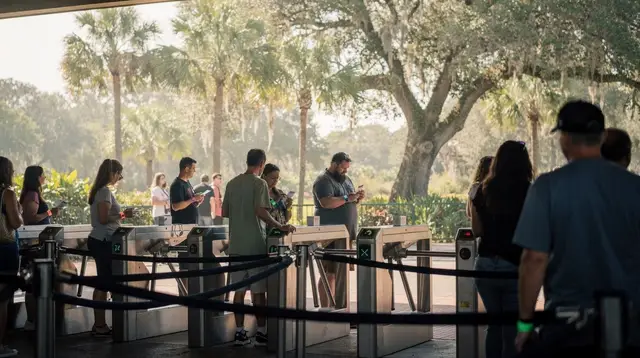
The picture and the day it was cropped from
Every image that sells Orlando is taken at the same two moments: right after the gates open, when the light is soft and the crowd hasn’t arrived, or in the last hour before sunset, when the heat has broken and the color turns gold. Nobody photographs 3 p.m. in July, because 3 p.m. in July looks like a family standing in a shadeless line, squinting, waiting for a churro cart. That’s not a conspiracy. It’s just how marketing works everywhere, and it’s worth saying plainly once, because the gap between the photo and the day is the single biggest source of disappointment I hear about on this coast.
I’ve walked those parks in the wrong hours on purpose, to see what the brochures leave out. Here’s what’s actually there.
The walking, seen from ground level
The photos show a family strolling past a castle. What they don’t show is that you covered 20 kilometers (12 miles) by dinner and your feet know it. A single day at Magic Kingdom or Islands of Adventure is closer to a long hike than a stroll — the map is deceptively compact on paper and enormous on foot, because you’re not walking in a straight line, you’re doubling back for a locker, a bathroom, a stroller left at the wrong gate. I’ve read guides that treat this as a footnote. It isn’t. It’s the first physical fact of the day, and it explains more bad moods than any queue does. If you want the honest version before you go, the walking and queue realities are worth reading before the ticket math.
The queue photos are worse offenders. What gets published is the overhead shot — a winding, orderly line photographed from a bridge, almost architectural. What you actually experience is the line from inside it: the back of someone’s neck, the recorded voice repeating the same safety message, the slow shuffle forward that makes fifty minutes feel like ninety. No brochure shows a queue from the position everyone actually stands in.
Heat that a photo can’t carry
Marketing images are lit, not felt. A July afternoon here runs 32 to 34°C with humidity that makes the air feel solid, and the photograph of a smiling family in front of a fountain doesn’t transmit any of that. It doesn’t show the sunscreen running into someone’s eyes, the sudden need for the air-conditioned gift shop that has nothing you want to buy, or the almost-daily afternoon thunderstorm that clears the outdoor queues for an hour and sends everyone indoors at once. None of this is hidden information — it’s in every practical guide to Orlando’s summer heat and storms — but a photo simply can’t carry a sensation, so it doesn’t try, and the traveler who never read past the images arrives unprepared for something entirely predictable.
The parts of the frame that get cropped out
Step back from the theme park gate and the landscape changes fast. The parking lots at Walt Disney World and Universal are genuinely vast — you’ll take a tram or a boat just to reach the entrance you can already see. Construction walls are a permanent feature, not a temporary inconvenience; something is always being expanded, refurbished, or torn down, and the plywood barrier rarely makes it into a promotional shot. And International Drive, the strip most visitors sleep and eat on, is dense with the same chain restaurants and souvenir shops you’d find outside any American airport — useful, convenient, and almost nothing to do with the Florida the postcards sell. None of that is a defect in the destination. It’s just the infrastructure required to run parks that draw tens of millions of people a year, and infrastructure doesn’t photograph well.
Then there’s the car. Orlando’s attractions are spread across a metro area, not a walkable old town, and the connective tissue is the I-4 — an interstate that is chronically congested and semi-permanently under construction. A week here involves real time spent in traffic, checking tolls and the SunPass or E-PASS system, watching the I-4’s traffic patterns instead of the scenery. That commute never appears in a 15-second ad, but it’s a real fraction of every itinerary.
Why this isn’t a scandal
I want to be careful here, because it would be easy to write this as an exposé, and it isn’t one. Every destination on earth sells itself through its best fifteen minutes. Paris doesn’t advertise its Métro at rush hour. Nobody in a ski brochure shows you the lift line. Orlando isn’t lying by using its golden-hour shots — it’s doing what every place with something to sell does. The problem isn’t the photo. The problem is treating the photo as a forecast.
What separates a disappointed visitor from a satisfied one, in my experience, has almost nothing to do with the destination and almost everything to do with what they expected walking in. Someone who arrives thinking every hour will look like the postcard is set up to feel cheated by 2 p.m. Someone who arrives knowing there will be heat, lines, distance, and traffic — and budgets a slower pace, a pool afternoon, a day that isn’t two parks back to back — tends to leave describing the same trip as wonderful. The parks haven’t changed between those two people. Only the anticipation has.
What the photos miss going the other way
Here’s the part that surprised me most, and it cuts both directions. The brochures also fail to sell what’s genuinely there, off the theme-park script, because it doesn’t fit the same golden-hour formula.
A Florida spring on a weekday morning, before any tour bus arrives, is close to empty — 22°C water, no line, no ticket booth, nothing between you and the current. A rocket climbing off Cape Canaveral, watched from a public beach on the Space Coast rather than a paid grandstand, is one of the more genuinely startling things I’ve seen travel with a group of strangers who all went quiet at the same moment. And a manatee at Three Sisters Springs, drifting past at its own unhurried pace in December water, doesn’t need staging at all — it’s simply there, doing nothing for the camera. If you want to see that side of the region on the water, a trip like the semi-private Crystal River manatee swim or the Tampa Bay Serengeti-style safari tour shows a version of Florida that never makes the theme-park reel.
The trap, oddly, runs the same in both directions: building your expectations on images shot at blue hour and out of season, whether that’s an empty castle courtyard at dawn or a spring with nobody in it. Both are real. Neither is the average day. The honest version of Orlando sits somewhere between the brochure and the complaint thread — closer, usually, to the brochure than people expect once they stop comparing the afternoon to the photo. A slower evening on the water, like a sunset cruise past the Sunshine Skyway, tends to look almost exactly like its own picture, because nobody staged it to.
Questions I get asked about this
Is Orlando actually as hot and crowded as people say?
Yes, at midday in June through September, and yes at the major parks during school holidays. Neither fact appears in most marketing photos, but both are consistent and predictable rather than occasional bad luck.
Does this mean the parks aren’t worth the money?
No — it means the value depends on pacing. Two parks in one day with young kids in July is a self-inflicted problem, not a park failure; a slower schedule with a pool afternoon changes the same trip’s reputation entirely.
Where do I see the “unphotographed” side of Florida for myself?
Weekday mornings at the springs, a beach viewing point on the Space Coast during a scheduled launch, or a slow morning at Crystal River between November and March for manatees.
Is the traffic on the I-4 really that bad?
Often, yes, especially at rush hour and around construction zones that shift year to year — it’s a real time cost worth building into any multi-day itinerary, not an exaggeration.
Should I stay on-property or along International Drive?
Both work; the trade-off is walkable convenience against chain-restaurant density, covered in more detail in the on-property versus International Drive comparison.
Is there a way to budget for the real cost, not the brochure price?
Yes — start from an honest per-day estimate rather than a single ticket price; the breakdown in what a real park day costs accounts for parking, food, and the extras that don’t appear in the headline figure.
tours.Opinion
Verified deep-linked GetYourGuide tours. Book through these links and we earn a small commission at no cost to you.
GetYourGuide does not provide a product photo for this activity — the image shows the meeting point, photographed by us.