Orlando water parks: Volcano Bay, Disney, and Aquatica compared
Which Orlando water park is best: Volcano Bay, Disney's water parks, or Aquatica?
Volcano Bay (Universal) uses a virtual queue (TapuTapu) that lets you avoid standing in line, Disney's two water parks (Typhoon Lagoon and Blizzard Beach) trade queue convenience for theming and scale, and Aquatica leans family-friendly with a marine-park feel next to SeaWorld Orlando. All three are usually added to a multi-day theme park ticket rather than bought alone, and all close occasionally in winter for maintenance.
Three water parks, three very different days
Orlando has three water parks worth planning around, and they don’t feel alike. Universal Orlando Resort runs one, Volcano Bay, built around a single fictional island volcano and a wearable virtual queue system. Walt Disney World runs two, Typhoon Lagoon and Blizzard Beach, each with its own backstory and a scale that comes from decades of expansion. SeaWorld Orlando runs a fourth option, Aquatica, which sits next door to the marine park and leans more toward younger families and animal-adjacent theming. None of them are cheap add-ons, and none of them are essential on a first Orlando trip focused on the big theme parks — but for a trip of five days or more, especially in summer heat, one water park day is usually worth carving out.
This guide covers what actually separates the four options, roughly what they cost in 2026, when they’re worth avoiding, and the maintenance-closure trap that catches winter visitors more often than it should.
Volcano Bay: the virtual queue changes the day
Volcano Bay opened in 2017 on the site of the old Wet ‘n Wild, across from Universal’s main resort area on the west side of International Drive. Its single organizing idea, the Krakatau volcano at the center of the park, means most of the park’s sightlines and paths wrap around it, which keeps the layout compact compared with the other three parks.
The feature that actually matters for planning is TapuTapu, a wearable device tapped at each ride entrance that assigns a return time, similar to a virtual queue at a theme park. Instead of standing in a physical line, you get a notified window, then spend the wait floating the lazy river, eating, or relaxing on the beach. On a moderate-crowd day this genuinely removes the worst part of a water park visit — standing wet and sunburned in a slow-moving line. On the busiest days of summer, the park can reach capacity for new arrivals, and popular slides can stop issuing new TapuTapu return times well before closing, so an early arrival still matters even with the virtual system.
Volcano Bay day tickets run roughly 80 to 100 USD for adults in the 2026 range, higher during peak weeks, and it’s frequently discounted or bundled as an add-on day to a multi-day Universal ticket rather than bought as a standalone admission. If you’re already planning a multi-day park itinerary that needs airport-to-resort transport sorted out, folding a Volcano Bay day into that same ground transportation plan is the simplest way to handle logistics.
Typhoon Lagoon and Blizzard Beach: bigger, slower, more themed
Disney’s two water parks predate Volcano Bay by decades — Typhoon Lagoon opened in 1989, Blizzard Beach in 1995 — and both cover more ground than Volcano Bay, with more distinct themed zones spread across a longer walk. Typhoon Lagoon centers on a large surf-style wave pool and a storm-wrecked fishing village theme; Blizzard Beach imagines a Florida ski resort improbably melting in the heat, with the tallest slide of the group launching from a chairlift-topped summit.
Neither park uses a TapuTapu-style virtual queue system. Lines are physical, standing lines, the way water park queues have worked for decades. On a slow day that’s a non-issue; on a packed July afternoon it means real wait times on the marquee slides, more comparable to a standing line at a theme park than to Volcano Bay’s wander-and-return model. What Disney’s parks trade for that is scale and theming depth — more lounging space, more distinct areas to explore, and for many families a more immersive feel than Volcano Bay’s tighter footprint.
Only one Disney water park operates at a time in the off-season. Disney has historically rotated seasonal refurbishment closures between Typhoon Lagoon and Blizzard Beach, closing one for weeks at a stretch, typically sometime in the December to February window, while keeping the other open. This is the single most common planning mistake on this page: booking a winter trip assuming both are open, then finding one shut for maintenance with no advance notice built into the trip plan.
Disney water park admission runs in a similar range to Volcano Bay, roughly 80 to 100 USD per day for an adult in 2026, and like Universal’s park it’s usually cheaper as an add-on to a multi-day ticket than as a standalone purchase. Unlike the main gates, Disney water parks don’t currently require the same advance date-specific reservation system as the theme parks — check the official calendar close to your date regardless, since capacity limits and closures are announced there first.
Aquatica: the family-leaning, marine-adjacent option
Aquatica sits across International Drive from the main SeaWorld Orlando gate and shares its marine-park sensibility — several habitats let you view dolphins and other marine life from the water park itself, which is a genuine point of difference from the other three. It skews toward families with younger children more than Volcano Bay or Disney’s parks, with a larger proportion of gentle slides, splash areas, and a beach-style wave pool alongside a handful of steeper attractions for older kids and teens.
Aquatica is also the one most commonly discounted or included free with certain SeaWorld annual pass tiers, and it’s the smallest of the four in footprint, which makes it realistic to combine with a same-day SeaWorld visit for families who don’t want two separate long days. Admission for 2026 runs roughly 70 to 90 USD for an adult day ticket bought alone, less as part of a combined pass. If Aquatica is the plan, an Aquatica Water Park admission ticket booked ahead avoids a walk-up line at the gate on a hot morning.
How the four compare
| Park | Opened | Queue system | Best for | Typical adult day price (2026) |
|---|---|---|---|---|
| Volcano Bay (Universal) | 2017 | TapuTapu virtual queue | Avoiding standing lines, compact layout | ~80-100 USD |
| Typhoon Lagoon (Disney) | 1989 | Standing line | Wave pool, theming, slow pace | ~80-100 USD |
| Blizzard Beach (Disney) | 1995 | Standing line | Tallest slides, scale | ~80-100 USD |
| Aquatica (SeaWorld) | 2008 | Standing line | Young children, marine-life views | ~70-90 USD |
Prices shift by date and season at all four — a summer weekend costs more than a random Tuesday in October — and every figure above is before Florida sales tax. Treat these as ranges to plan around, not quotes.
Buy it alone, or add it to a multi-day ticket?
At all three operators, a water park day is almost always cheaper as an add-on to a multi-day theme park ticket than as a standalone purchase. If your Orlando trip already involves multiple theme park days and ground transport between the resort and the parks, check the ticket options for a water park add-on before buying separate admission at the gate. For details on how Disney and Universal structure their multi-day tickets and passes, see the full ticket breakdowns for Walt Disney World and Universal Orlando.
A water park day is a full commitment on its own — changing, lockers, sunscreen, sun exposure, and several hours on your feet or in the water — so pairing it with a dry theme park on the same day is more tiring than it sounds. Most people who visit more than one park type on a trip split them across separate days.
Season and weather: the part that actually changes your day
June through August is peak season and peak crowding. These are also the hottest, most humid months in Central Florida, with air temperatures regularly in the low-to-mid 30s C, which is exactly when a water park is most appealing and most crowded at the same time. Arrive at opening if you go in summer; the first two hours are consistently the calmest window before lines lengthen and the sun gets brutal.
Afternoon thunderstorms are a near-daily event in summer, usually arriving mid-to-late afternoon and lasting anywhere from 15 minutes to over an hour. Lifeguards clear pools and slides the moment lightning is detected within range of the park, and re-opening only happens after a mandatory clear period once the storm passes — sometimes a full round of closures repeats if a second cell moves through. This is standard operating procedure, not a park malfunction, but it does mean a summer afternoon at any of these four parks can include real downtime. Morning arrivals reduce how much of your day that downtime eats into. For more on what a Florida summer afternoon actually involves, see the summer heat and storms guide and, during hurricane season specifically, the hurricane season travel guide.
Winter is the trap. December through February is the cheapest and least crowded stretch on the calendar for the main theme parks, and it’s tempting to assume a water park day fits neatly into a winter itinerary too. Two things work against that. First, at least one Disney water park is likely to be closed for its seasonal refurbishment somewhere in this window, and Volcano Bay and Aquatica also run their own maintenance closures on individual attractions or full-park days at various points in winter — always check the specific park’s calendar before booking, not just the resort’s general operating hours page.
Second, air temperature matters more than most visitors expect: mornings in December through February often start near 10 C, and a passing cold front can push overnight lows close to freezing for a night or two. Operators sometimes close pools, or the wave pool specifically, when air temperature drops below roughly 21 C, even on a day the park’s calendar lists as open. A water park visit scheduled for a cold snap in January can mean a nearly empty park and a cold, short session rather than the warm, crowd-free day it looks like on paper. Check both the maintenance calendar and the forecast before locking in a winter water park date — see Orlando in winter for what the season is actually like outside the water parks.
Spring and fall are the better bet for most visitors. Late April through May and October through November combine warm air and water temperatures with lower crowds than summer and a much lower chance of a maintenance closure than deep winter.
Practical notes before you go
- Lockers cost extra at all four parks and aren’t included in admission; renting one for the day is worth it rather than leaving valuables at a towel spot.
- Refillable cups and food work the same way as at the main theme parks — bringing your own water bottle to refill is allowed and recommended given the heat.
- Life jackets are free at every park for anyone who wants one, no rental fee, and lifeguards will point out the counter on request.
- Reef-safe sunscreen is worth packing; some standard sunscreens are restricted in pools and wave pools at these parks.
- Families choosing between the youngest kids and older teens should weigh Aquatica’s gentler mix against Blizzard Beach’s taller slides — see Orlando with toddlers and preschoolers and Orlando with teenagers for how that split plays out across a whole trip, not just the water park day.
- If International Drive is your base, ICON Park and the wider International Drive attractions make an easy pairing for an evening after a water park day, and the choice of staying on property versus International Drive affects how far the water park commute actually is.
- For how a water park day fits into overall trip spending, see the Orlando trip cost breakdown.
- A cooler evening after a hot pool day works well for something indoors and air-conditioned — a dinner show such as Medieval Times’ dinner and show near Kissimmee or an evening flight such as an after-hours helicopter flight over the theme park corridor both make a reasonable second half of the day once the pools close.
- None of this covers Florida’s natural springs, which hold at a constant 22 C year-round and are a genuinely different experience from a chlorinated water park — that’s covered separately in the Florida springs day trip planner.
Frequently asked questions about Orlando’s water parks
Do I need a separate ticket for Volcano Bay, Disney’s water parks, or Aquatica?
Yes, each is a separate admission from the main theme parks, though all three are commonly bundled onto a multi-day or annual pass at a lower add-on rate than a standalone day ticket. Buying just a single water park day, with no other park visit, is the most expensive way to do it.
Is Volcano Bay’s virtual queue really worth it?
For most visitors, yes. TapuTapu wristbands let you join a ride’s virtual line, then wander the park, eat, or float the lazy river while you wait instead of standing in a physical queue. On the busiest summer days the park can still reach capacity and stop issuing new virtual queue times for some slides by midday.
Which is bigger, Volcano Bay or Disney’s water parks?
Blizzard Beach and Typhoon Lagoon are both larger than Volcano Bay in raw acreage, with more separate themed zones and a slower, more sprawling layout. Volcano Bay is more compact and easier to cover in a single day without a lot of walking.
Do Orlando water parks close in winter?
Yes. All of them run seasonal refurbishment closures, typically for one park at a time between December and February, and some individual slides or the wave pool can close for maintenance even when the park itself is open. Always check the specific park’s calendar before booking a winter date.
Is it too cold to visit a water park in Orlando in winter?
It can be. Central Florida mornings in December through February often start near 10 C, and a cold front can push air temperatures close to freezing for a night or two. Water park operators sometimes close pools or reduce hours when air temperature drops below about 21 C, even if the park’s calendar shows it as open.
Can I visit a water park and a theme park on the same day?
It’s possible logistically since parking and shuttles connect them, but it’s a heavy day: a water park is its own multi-hour visit with changing, lockers, and sun exposure. Most people who do both split them across separate days rather than combining them.
Are afternoon thunderstorms a real problem at Orlando water parks?
Yes, especially June through September. Lifeguards clear pools and slides for lightning within range of the park, sometimes for 30 minutes or more per storm, and a summer afternoon can bring more than one round. Mornings are the more reliable window in high summer.
Theme park tickets and passes on GetYourGuide
Verified deep-linked GetYourGuide tours. Book through these links and we earn a small commission at no cost to you.
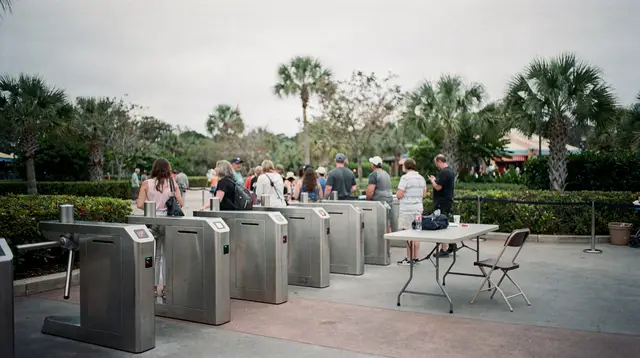
GetYourGuide does not provide a product photo for this activity — the image shows the meeting point, photographed by us.