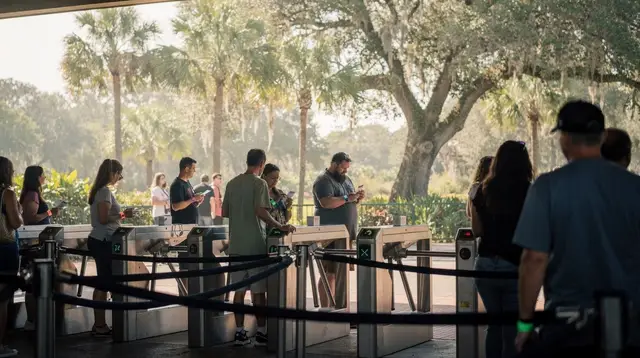
Orlando with teenagers: a trip built for thrill-seekers
What makes an Orlando trip work for teenagers specifically?
Lean into thrill rides at Islands of Adventure, Epic Universe and Volcano Bay, add water sports and a bioluminescent kayak trip on the coasts, give teens supervised independence with a fixed meeting time and a charged phone, and break up park days with a beach day so nobody burns out by day four.
Why a teenage trip is a different trip
A family with a toddler plans around nap times and stroller access. A family with grandparents plans around pacing and shade. Neither of those constraints applies to a group of 13 to 18 year-olds, and pretending otherwise wastes a real advantage: teenagers can handle long days, big drops, and a schedule with less structure than younger kids need. What they need instead is enough thrill content to stay interested, real independence with real boundaries, and a budget line for the things that are entirely theirs — an arcade credit, a milkshake at midnight, a photo op that has nothing to do with the itinerary their parents built.
This guide skips toddlers and seniors on purpose and goes straight at the questions that come up with a teenage crew: which parks actually deliver on thrills, what water sports and coastal activities are worth the drive, how much independence is reasonable inside a park, and how to avoid the single most common mistake — burning a group out with two heavy park days in a row and no plan for what happens if someone gets separated.
The thrill lineup: where the big rides actually are
Not every park in Orlando is built the same way, and for a teenage-focused trip the ranking matters more than the brand.
Islands of Adventure, part of Universal Orlando Resort, has carried the region’s steepest thrill lineup for years and still does. It also holds Hogsmeade, one half of The Wizarding World of Harry Potter, which teenage Potter readers who grew up on the books still respond to more than parents usually expect.
Epic Universe opened on May 22, 2025, as Universal Orlando Resort’s fourth gate, and it shifted the thrill math for the whole area. It is built around large-format, technically ambitious rides rather than family-friendly spinners, which makes it the single best addition to an Orlando itinerary for teenagers in years. Note that the Hogwarts Express, which links the two Wizarding World lands, requires a park-to-park ticket — the most common booking mistake among first-time visitors, teenage-heavy groups included.
Magic Kingdom and the rest of Walt Disney World skew younger in ride profile, with exceptions — Tron Lightcycle / Run and Space Mountain hold up for teenagers, and EPCOT’s evening crowd and food-stall culture plays well with a slightly older group even without big drops.
Volcano Bay, Universal’s water park, is a good mid-trip choice specifically because it lowers the intensity without lowering the fun: a water park day still delivers thrill slides but costs less physically than a full day of standing in line at a gated thrill park.
Busch Gardens Tampa Bay sits about 1 hour 30 minutes away on the gulf-coast side, and for a group that rates a trip by its coaster count, it is worth the drive on its own — the coaster lineup there is faster and steeper than anything inside Orlando’s core parks. Pairing it with a Tampa day covering Tampa and Ybor City turns one long drive into a full day trip rather than a rushed side errand.
Thrill-park comparison at a glance
| Park | Best for | Distance from Orlando | Notes |
|---|---|---|---|
| Islands of Adventure | Steepest coasters, Wizarding World | In Orlando | Park-to-park ticket needed for the Hogwarts Express |
| Epic Universe | Newest large-format rides | In Orlando | Opened May 22, 2025 |
| Volcano Bay | Lower-intensity thrill day | In Orlando | Good mid-trip reset |
| Magic Kingdom / EPCOT | Scale and evening atmosphere | In Orlando | Fewer big-drop rides than Universal |
| Busch Gardens Tampa Bay | Fastest, steepest coasters overall | About 1 hour 30 minutes | Pair with a Tampa day |
Beyond the gates: what actually lands with this age group
Parents planning an Orlando trip default to parks, and for teenagers that is only half the itinerary that works. Water and open-air activities consistently score better with this age group than a second museum or a slow-paced garden walk.
Springs kayaking puts teenagers on clear, spring-fed water that runs about 22°C (72°F) year-round, which reads as a genuinely different Florida than the theme-park corridor. A guided run works better than a rental for a first-timer group, since a guide keeps pace and points out wildlife instead of leaving a group of teenagers to navigate alone.
a guided Rock Springs Run kayak trip with a picnic lunch built inis a full half-day that swaps screens for a paddle without feeling like a forced nature lesson — read more on kayaking the Wekiwa Springs run for what the paddle itself involves.
Jet skiing and parasailing on either coast give a faster, louder alternative for a group that wants speed without a ride queue. See jet ski and parasailing options on the gulf coast for where these run out of Clearwater and the barrier islands.
For a slower paddle with a wildlife payoff, a guided sunset kayak tour works as an evening activity that does not compete with a park day — it starts late enough to follow a morning at the parks and still gets a group back before it is genuinely late.
Bioluminescent kayaking on the Space Coast is one of the few activities on this site that is genuinely hard to replicate anywhere else a teenager is likely to travel. It runs from June to October in the Indian River and Mosquito Lagoon, best around the new moon, and it is worth being honest about: the glow comes from a dinoflagellate whose intensity varies night to night, so it is never a guaranteed spectacle, only a strong likelihood in season. Full planning detail is in bioluminescent kayaking on Mosquito Lagoon and season and moon planning for bioluminescence.
Airboats on the Kissimmee marshes are 30 minutes from the parks and deliver noise, speed, and alligators in one hour — a reliable teenage crowd-pleaser precisely because it asks nothing of anyone’s patience.
an airboat tour with alligator and wildlife viewingruns well as a between-parks morning. These marshes are upstream of the real Everglades, not the Everglades themselves — the actual Everglades are about 3 hours 30 minutes south and are not a realistic day trip from Orlando.
Fishing is a lower-energy option for a mixed group where not every teenager wants a full water-sports day.
a guided inshore fishing tripworks for a smaller subset of the group without stranding anyone who would rather sit a morning out.
ICON Park after dark, on International Drive, is the single best evening activity for teenagers who want to walk somewhere without a car, without a wristband, and without a parent hovering. The Wheel lit up at night, an arcade stop, and a food-truck dinner cover an evening well. Note that International Drive’s paid attractions are separate businesses, not extensions of the theme parks, and pricing there is genuinely uneven — some stops are worth it, some are not.
an arcade and mystery fun house adventure
is a straightforward option for a rainy afternoon or a low-key evening that does not require driving anywhere.
Independence: how much, and how to structure it
This is the question every parent of a teenager asks about Orlando and the one the parks themselves stay quiet on. Neither Universal Orlando Resort nor Walt Disney World sets or enforces a minimum age for splitting a group up inside the gates — a family with 14 and 16 year-olds who want to ride Islands of Adventure’s biggest coasters without an adult in line can do it, and plenty do.
What makes it work is structure the family sets, not a rule the park hands down:
- A fixed meeting time and place, agreed before anyone splits off, ideally at a landmark that is easy to describe over a bad phone connection — a park entrance, a specific restaurant, not “somewhere near the castle.”
- A charged phone for every teenager, checked before departure, with a portable charger in a bag if the group plans to be out past mid-afternoon. Phone batteries in Florida heat drain faster than at home, and a dead phone in a crowd of tens of thousands turns a minor delay into a genuine problem — this is the single most common failure point in teenage independence at the parks, and it is entirely avoidable.
- Mobile coverage inside Walt Disney World and Universal Orlando Resort is generally solid on major US carriers, but international visitors should confirm their plan covers US data before relying on it as the only communication method; a downloaded offline map of the resort as backup costs nothing.
- A pocket-money budget, set in advance rather than negotiated mid-day. A workable 2026 range is 40 to 70 USD per teenager per day for snacks, an arcade stop, or a photo, on top of tickets and meals the family has already covered, and that figure sits before the local sales tax — 6 percent state plus a county surtax, 6.5 percent in Orange County, 7.5 percent in Osceola County — that applies at checkout.
- A backup plan for a lost phone or a missed meeting, stated out loud before splitting up: which park employee to find, which gate to return to, what “wait 30 minutes at the meeting point before escalating” actually means in practice.
None of this requires an app or a subscription. It requires saying it out loud once, before the group scatters, rather than assuming everyone already agrees on the plan.
The fatigue trap: two thrill days in a row
The single most predictable mistake in a teenage Orlando itinerary is stacking two full thrill-park days back to back. It looks efficient on paper — teenagers have the stamina, the argument goes, so pack the schedule. In practice, the combination of Florida heat, 15 to 25 kilometers of walking a day, adrenaline spikes from repeat coaster riding, and often too little sleep the night before wears a group down faster than parents expect, and it shows up as the third day of a trip, not the second: shorter tempers, less patience for lines, more complaints about small things.
A beach day breaks that cycle without feeling like a downgrade. Cocoa Beach on the Atlantic side and Clearwater or Siesta Key on the gulf side both give a teenage group something to do that is not standing in a queue — surfing, paddleboarding, or simply a few hours where nobody is checking a wait-time app. See things to do around Clearwater for how a gulf-coast beach day slots into a Central Florida trip. One rest or beach day placed after the first big thrill-park day, rather than saved for the end of the trip, keeps the second thrill day sharper than pushing straight through.
Sample structure for a teenage-focused week
| Day | Focus |
|---|---|
| 1 | Arrival, MCO transfer, settle in, evening at ICON Park |
| 2 | Islands of Adventure, full thrill day |
| 3 | Epic Universe |
| 4 | Beach or springs reset — kayak or coastal water sports |
| 5 | Volcano Bay, lower-intensity thrill day |
| 6 | Day trip to Tampa and Busch Gardens Tampa Bay |
| 7 | Space Coast: bioluminescent kayak (summer) or an airboat morning, departure prep |
This is a starting frame, not a fixed script — see the two-day Universal Orlando Resort itinerary for a tighter version if the trip only covers Universal, and where to base yourself around Orlando for how hotel choice changes drive times to the Space Coast and gulf-coast days.
Budget notes for 2026
Park-day pricing moves by date, not by season label, and the same single-day, single-park ticket can run from around 119 USD in the second half of January to around 199 USD between Christmas and New Year’s — always check the specific dates before assuming a figure. On top of the ticket, a Lightning Lane Multi Pass or an Express Pass supplement, priced per person per day, is worth budgeting for with a teenage group specifically, since standing in standard lines for the marquee coasters eats into the hours where thrill content actually happens.
Families staying in a Loews premium hotel at Universal — Portofino Bay, Hard Rock, or Royal Pacific — get Express Pass access included, which changes the math meaningfully for a coaster-focused trip. None of these figures include the sales tax added at checkout, and resort fees of roughly 20 to 40 USD a night are common at International Drive and Kissimmee hotels but rarely shown in the advertised room rate. See the Orlando trip cost breakdown for a fuller line-by-line picture.
Frequently asked questions about an Orlando trip with teenagers
Which parks have the best rides for teenagers?
Islands of Adventure at Universal Orlando Resort has the steepest thrill lineup in the region, and Epic Universe, open since May 2025, added a fourth gate of large-format rides. Volcano Bay works for a slower, water-park pace mid-week.
Can teenagers roam a park without an adult?
Universal Orlando Resort and Walt Disney World allow it informally for teens old enough to carry a phone and a ticket, but neither operator enforces a minimum age for splitting up inside the gates. Families set their own rule, not the park.
How much spending money should a teenager have per day?
A workable range in 2026 is 40 to 70 USD a day for snacks, a photo, and an arcade or ICON Park stop, on top of whatever the family has already paid for tickets and meals, before the 6 to 7.5 percent sales tax that applies at checkout.
Is Busch Gardens Tampa Bay worth the drive for a teenage crowd?
Yes for coaster-focused teens: it is about 1 hour 30 minutes from Orlando and has a steeper, faster coaster lineup than anything in the Orlando parks, and it pairs well with a Tampa day that also covers Ybor City.
What is the biggest planning mistake with teenagers in the parks?
Letting a group split off for a full day without a fixed regroup time and location, and without checking that phones are charged. A dead phone in a crowd of tens of thousands turns a minor delay into a real problem.
Should teenagers do two thrill parks back to back?
It is possible but it wears a group down faster than adults expect, between heat, walking 15 to 25 kilometers a day, and the adrenaline crash. One rest or beach day mid-trip keeps the second thrill day sharper.
What non-park activities actually land with teenagers?
Kayaking a clear spring, jet skiing or parasailing on the coast, a summer bioluminescent kayak trip on the Space Coast, and an evening at ICON Park on International Drive consistently work better with this age group than a museum stop.
Family travel guides for every age on GetYourGuide
Verified deep-linked GetYourGuide tours. Book through these links and we earn a small commission at no cost to you.
GetYourGuide does not provide a product photo for this activity — the image shows the meeting point, photographed by us.