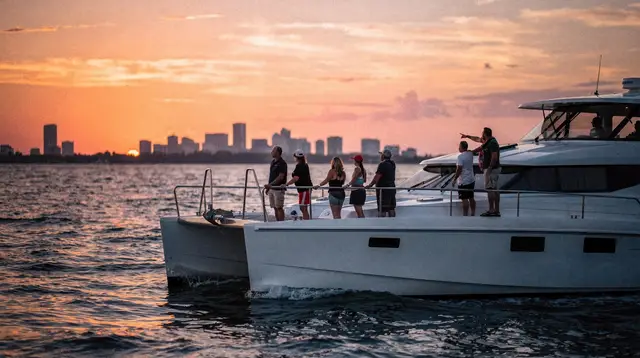
Daytona Beach boat tours on the Intracoastal, not the ocean
Why take a boat tour on Daytona's Intracoastal instead of out into the ocean?
The Halifax River and Intracoastal Waterway stay flat and sheltered behind the barrier island, so resident dolphins, passing manatees and wading birds are easy to see at close range. Most trips run 1 to 3 hours from downtown Daytona Beach or Ponce Inlet docks, and they run in conditions that would cancel an offshore boat.
Most visitors picture Daytona Beach as sand, surf and the hard-packed strip where cars still drive. The better boat trip runs the other direction, inland, on the Halifax River and the Intracoastal Waterway that separates the barrier island from the mainland. It is flatter water, more wildlife per hour, and a far more comfortable ride for anyone traveling with kids or a queasy stomach.
Why the Intracoastal beats an ocean run
The Atlantic off Daytona Beach is open water: wind chop, swell and no real shelter once a boat clears the inlet. The Halifax River and the Intracoastal Waterway sit behind the barrier island, protected on both sides. That difference changes the whole experience. The ride is smoother, engines run slower and quieter, and a guide can hold position near a dock piling or a mangrove edge without fighting current the way an ocean boat has to.
It also changes what you see. Bottlenose dolphins live in the Halifax River year-round, feeding along channel edges and cutting wakes behind moving boats. Manatees move through seasonally, especially as water cools, grazing on grass beds in the shallows. Ospreys nest on channel markers, brown pelicans line the docks, and great blue herons stand motionless in the shallows at low tide. An ocean tour trades all of that for open horizon and a rougher ride.
None of this is staged. It is a working waterway shared with local boat traffic, fishing guides and residents, and wildlife sightings depend on the day, the tide and the season. A good operator will say so rather than promise a dolphin on every trip.
Formats available
Operators around Daytona Beach run a handful of formats, and the right one depends on time available and who is in the group.
Short narrated wildlife cruise. The most common format: 1 to 1.5 hours, a captain narrating history and pointing out wildlife along the way, departing from a downtown dock or from Ponce Inlet to the south. This is the easiest option for families with young children who won’t sit still for three hours.
Sunset cruise. Timed to leave the dock with enough run time to be on open water as the sun drops behind the mainland tree line. Expect around 1.5 to 2 hours, often with a drink service on board. Book ahead in the shoulder seasons, since sunset departures sell out faster than midday ones.
Longer coastal discovery cruise. A slower-paced trip that can run close to 3 hours, covering more of the river and giving more time for wildlife stops rather than a fixed loop.
Private small boat charter. Several operators offer a smaller boat that can be booked exclusively for one family or group rather than joining a shared departure. This costs more per person but gives control over timing, pace and where the boat lingers, which matters if the group includes toddlers who need a shorter run or grandparents who want a slower pace.
| Format | Typical length | Best for |
|---|---|---|
| Short narrated wildlife cruise | 1–1.5 hours | Families, first-timers, tight schedules |
| Sunset cruise | 1.5–2 hours | Couples, photography, evening plans |
| Coastal discovery cruise | Up to 3 hours | Visitors prioritizing wildlife time over speed |
| Private charter | Custom | Groups wanting flexibility and privacy |
For an active option on the same water, a paddle tour covers similar ground at a slower pace: see a Daytona dolphin and manatee paddle or kayak tour. For a fixed-length boat trip that covers more of the river in one sitting, a 3-hour coastal discovery boat cruise is the longest standard option. For evenings, a small-group champagne sunset cruise keeps the group size down. On land near the dock, a guided e-bike tour of the lighthouse and harbor area pairs well before or after a cruise.
Getting there from Orlando
Daytona Beach sits about 90 km (56 miles) from Orlando, roughly 1 hour by car via I-4 east. It’s a realistic day trip: leave in the morning, take a midday or early-afternoon boat slot, and still have time to walk the historic district or the Ponce Inlet lighthouse grounds before heading back. Docks cluster along the downtown riverfront and around Ponce Inlet to the south; confirm the exact departure point when booking, since the two areas are a 20-minute drive apart.
Most visitors do this drive in a rental car; see renting a car in Central Florida and how SunPass and E-Pass tolls work if the route includes toll roads. Traveling without a car is harder for this particular trip, since the docks aren’t on a fixed transit line from Orlando — for the general tradeoffs, see airport transfer options compared and getting around without a car.
Manatee season and timing
Manatees aren’t a guaranteed sighting on any single trip, and they move through the Halifax River seasonally rather than living there year-round the way the resident dolphin population does. Sightings pick up as water cools in late fall and winter, when manatees seek warmer, sheltered water — the same pattern that draws them to Central Florida’s springs, which stay a constant 22°C (72°F) twelve months a year regardless of the season outside. For the month-by-month pattern across the state, see manatee season month by month; for the etiquette that applies whether you’re on a boat or in the water near one, see manatee encounter rules and etiquette.
Daytona’s boat tours are a passive, from-the-deck way to see manatees, different from an in-water encounter. Travelers who specifically want to be in the water with manatees, rather than watching from a boat, are usually better served by Crystal River on the Gulf Coast or the observation platforms at Blue Spring near the St. Johns River — see manatee tour: boat versus kayak for how the formats compare.
Pairing a Daytona trip with the rest of the Atlantic coast
Daytona sits roughly between two other draws on this side of the state, which makes it easy to fold a boat tour into a longer coastal day or a multi-stop trip rather than treating it as a stand-alone outing.
To the south, St. Augustine is about an hour’s further drive and pairs naturally with an early Daytona boat slot followed by an afternoon in the old town — see St. Augustine old town tour for first-timers and St. Augustine’s own harbor cruise if a second, different boat trip on the same visit appeals. For travelers building a full day around it rather than a quick add-on, one day in St. Augustine from Orlando lays out the timing.
To the south along the coast toward Orlando, the Space Coast and the Kennedy Space Center Visitor Complex sit about an hour from Kennedy Space Center’s Merritt Island location, launches permitting — see watching a rocket launch from Titusville and one day at Kennedy Space Center from Orlando. Travelers building a longer Atlantic-side trip that strings Daytona, the Space Coast and St. Augustine together can start from ten days: space history and the Atlantic shore.
If you’re based on the Gulf Coast instead
Not every trip starts from Orlando or the Atlantic side. Travelers based on the Gulf Coast, or splitting a trip between both coasts, have comparable boat-tour options closer to Tampa, St. Petersburg, Clearwater and Sarasota — see dolphin watching in Clearwater, Tampa Bay sunset cruise and Sarasota Bay dolphin and wildlife cruise. The pattern is the same as Daytona’s Intracoastal: sheltered bay and estuary water rather than open Gulf, calmer rides, and dolphins as the most reliable sighting. Closer to Orlando itself, the St. Johns River eco-cruise covers freshwater wildlife rather than coastal, and the Winter Park scenic boat tour is a short, low-key option that doesn’t require a day trip at all.
What to bring
Sun protection matters more than most first-time visitors expect, even on a covered or partly shaded boat: reef-safe sunscreen, a hat, and sunglasses. Mornings can run cool enough for a light layer, especially on winter departures, but afternoons warm up quickly. Closed-toe shoes aren’t required on most tours, but a secure pair beats flip-flops on a moving deck. Binoculars help for spotting wildlife at a distance, particularly ospreys and herons that don’t let a boat approach closely. Most operators allow drinks and light snacks on board; check the specific boat’s policy when booking, since some run their own bar service instead.
Weeks to avoid or plan around
Daytona Beach runs on an event calendar that reshapes the whole town, and it’s worth checking before locking in dates.
Race weeks. Daytona International Speedway hosts the Daytona 500 in February, preceded by Speedweeks, and other major race weekends through the year. During these stretches, hotel rates spike, rooms sell out weeks in advance, and beachside roads see heavy traffic.
Motorcycle rallies. Bike Week in early March and Biketoberfest in mid-October bring large numbers of motorcycles into town, filling hotels and slowing traffic along the A1A and the beachside core.
None of this cancels boat tours themselves, but it changes everything around them: parking, hotel prices, and the drive to the dock. A boat trip scheduled during one of these weeks can lose more time sitting on the A1A than actually on the water. Check the Daytona International Speedway event calendar and general event listings before booking a date, particularly if flexibility is limited.
Weather and cancellation policies
Central Florida’s pattern of near-daily summer thunderstorms (see hurricane season and summer storm timing) affects the Intracoastal the same way it affects everything else in the region: brief but intense afternoon storms, most common from June through September. Operators typically cancel or delay for lightning, sustained high wind, or an active storm cell, since a boat on open water is the wrong place to be during a lightning event even on sheltered water.
Most companies either refund the trip in full or offer a free rebooking to another time slot when they cancel for weather. This is standard practice, but terms vary by operator, so check the specific cancellation policy at the time of booking rather than assuming. Morning departures generally have a better weather record than afternoon ones in summer, since storms tend to build later in the day.
What this page does not cover
This guide is about boat trips on the Halifax River and Intracoastal Waterway specifically. It doesn’t cover the beach itself, driving on the sand, surfing, or other water sports — those are handled separately. It also isn’t about offshore fishing charters or deep-sea trips, which launch into the Atlantic and follow different timing and conditions.
The main mistake to avoid
The single most common planning error is booking a Daytona day trip during a major race or rally week without checking first, then losing the morning to traffic on the A1A before ever reaching the dock. Check the event calendar, confirm the exact dock location when booking, and build in extra drive time during any event week. A short boat ride on calm water is the point of the trip; don’t let the drive there use up more of the day than the water does.
Daytona Intracoastal boat tours: frequently asked questions
Is the Intracoastal Waterway the same as the ocean in Daytona Beach?
No. The Halifax River and the wider Intracoastal Waterway run on the mainland side of the barrier island, separated from the Atlantic by miles of beach and dunes. The water is calmer, shallower in places, and lined with mangroves and docks rather than open surf.
What wildlife will I actually see on a Daytona boat tour?
Bottlenose dolphins live in the Halifax River year-round and are the most reliable sighting. Manatees pass through seasonally, more often in cooler months, and ospreys, pelicans and herons are common along the shoreline. None of this is guaranteed on any single trip.
How long are these boat tours?
Most narrated wildlife trips run 1 to 1.5 hours, sunset cruises run around 1.5 to 2 hours, and a longer coastal discovery cruise can run close to 3 hours. A privatized small boat can be booked for a custom block of time.
Can I book a private boat for a family or small group?
Yes. Several operators offer a smaller boat that can be booked for a private group rather than joining a shared departure, useful for families with young children or a group that wants flexibility on timing.
When is Daytona Beach hardest to visit because of events?
Weeks built around Daytona International Speedway races, especially February’s Daytona 500 and the surrounding Speedweeks, and the large motorcycle rallies in early March and mid-October, fill hotels and clog the A1A and beachside roads. Check the event calendar before booking dates.
What happens if a boat tour is cancelled for weather?
Operators cancel or reschedule for high wind, lightning and thunderstorms, which are common on summer afternoons. Most Daytona boat operators offer a refund or a free rebooking when they cancel; check the specific policy at booking, since terms vary by company.
How far is Daytona Beach from Orlando?
About 90 km (56 miles), roughly 1 hour by car via I-4, making it a workable day trip from the Orlando parks corridor.
Scenic boat cruises and sunset river tours on GetYourGuide
Verified deep-linked GetYourGuide tours. Book through these links and we earn a small commission at no cost to you.
GetYourGuide does not provide a product photo for this activity — the image shows the meeting point, photographed by us.